 50-CENTS | An IAS Institute.
Table of Contents:
1. Introduction: Delight of Delhi Air Pollution Crisis.- Delhi Air Pollution Crisis is not going away and its levels of hazardous AQI are steadily increasing every winter.
- Millions of people inhale poisonous air on a daily basis transforming the Indian capital into a zone of emergency cases.
- The crisis is the result of unplanned development of the years and poor pollution control measures.
- The main factors are stubble burning, industrial smoke, automobile emissions and dust.
- Delhi has a high pollution of air due to poor management of its waste and old transport policies.
- The toxic cloud of the city is contributed by regional factors of Punjab, Haryana, and UP.
- The quality of air in Delhi is reduced dramatically during October through January annually.
- Low temperatures and humid winds leave the pollutants and make smog to be very severe.
- The maximum occurrence of the pollution crisis of air in Delhi happens after Diwali because of firecrackers and burning of crops.
- An increase in the number of cases of asthma and bronchitis and eye irritation are indicative of the health tragedy.
- The pollution in Delhi impacts on the workforce productivity, and the cost of medical services.
- It is still the children and the aged who continue being the hardest hit by this long-running health crisis.
- Blame games occur in politics at the expense of fast environmental reforms.
- The air pollution crisis is aggravated by inaction even after the local courts issue multiple court orders in source areas.
- Clean air has become a luxury rather than a right due to the governance failure.
- The Supreme Court and NGT make timely orders, but there is a poor implementation.
- Anti-pollution laws are not uniformly enforced in spite of several hearings.
- Powerful judicial intervention is required to make the Delhi Air Pollution a permanent one.
- Opposition on political front is an issue that is usually followed up.
- The debate on accountability substitutes long-term solutions to air Quality.
- Delhi Air Pollution should be united and not politicised.
- India should establish a National Clean Air Code so that they can standardise pollution.
- The real environmental accountability may be assured with strict timelines and penalties.
- It is not possible without a structured national code that the same scenario of air crisis in Delhi can be stopped.
- The growing level of pollution is compelling residents of Delhi-NCR to leave the place.
- The significance of the crisis is illustrated by brain drain and health migration.
- The nihil form of escape is not the answer - a collective action is.
- The people should insist that they have their right to clean air.
- Local pollution habits can be minimized through awareness campaigns.
- Individual behaviour Ideal individual behaviour is the beginning of Delhi Air Pollution control.
- Cut-edge air filters, electric cars and green landscape can be of assistance.
- Efficient implementation of a policy is as important as invention.
- Delhi should be held responsible in the adoption of environmental technology.
- Unless structural reforms are undertaken, the pollution levels might increase.
- The air quality crisis will be worsened as a result of climate change in Delhi.
- Without having an involvement of the people, 2030 might be the darkest year in terms of pollution in Delhi.
- The awareness and participation of the citizens are propelled by the NGOs, activists and local groups.
- The civil movements are able to make their governments be responsible. The Delhi Air Pollution Crisis protest requires the voice of every citizen.
- Enough is enough and it is time to switch blame to solutions.
- It is time to make clean air a national agenda as opposed to a Delhi issue.
- Even every act will be noticed before long: united India can breathe.
External Links:
The Hindu:-
To combat rising air pollution levels, doctors advocate adopting lifestyle changes. The Hindu.
- The Hindu Business Line – Air quality in Delhi deteriorates further; AQI touches 421, enters ‘severe’ category: https://www.thehindubusinessline.com/news/air-quality-in-delhi-deteriorates-further-aqi-touches-421-enters-severe-category/article70231885.ece 2. Wikipedia – Air pollution in Delhi (with policy reactions, health impact, sources, and Supreme Court remarks): https://en.wikipedia.org/wiki/Air_pollution_in_Delhi
Internal Links:
- क्या कृत्रिम बारिश दिल्ली-NCR के प्रदूषण संकट का स्थायी इलाज है?
-
Artificial rain Delhi NCR has been proposed as an emergency measure to reduce smog.
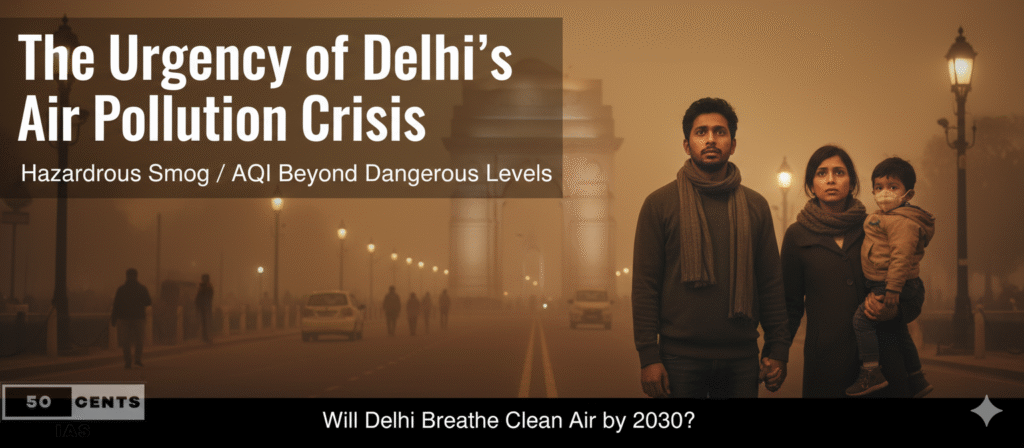
A family braves the hazardous smog in Delhi. Will India's capital breathe clean air by 2030 amidst the ongoing air pollution crisis?
Introduction: the Delhi Air Pollution Crisis.
Delhi the centre of India, has gained world notoriety, not because of its culture, food and history but because it topped AQI charts as the most polluted mega city in the globe. With the appearance of each winter, the toxic haze, which suffocates millions of people, also comes. The phrase Delhi Air Pollution has become a family passion which is filled with remorse and irony. The smog of Delhi is the only thing that is even more dense? Authoritative exemptions and the silent masses.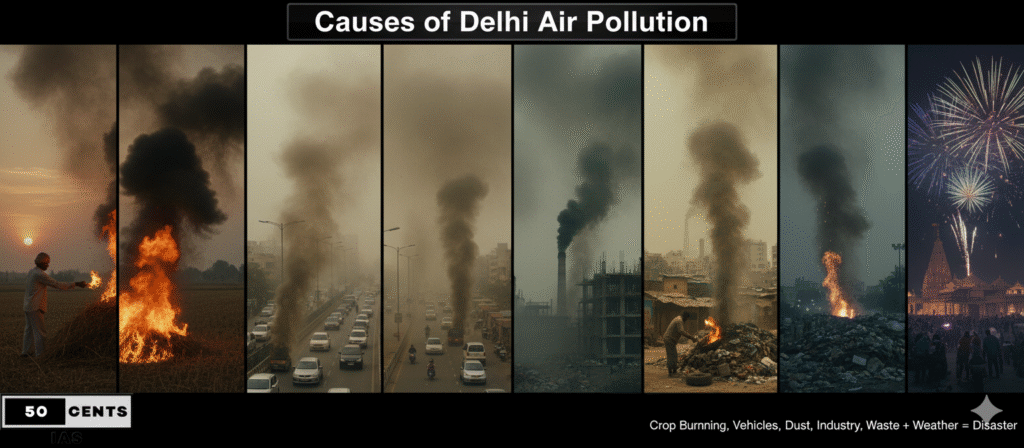
From crop fires to festive explosions: The complex and interconnected causes of Delhi's devastating air pollution.
Reasons of Air Pollution in Delhi.
The chief culprit in the problem is crop residue burning in Punjab and Haryana, subsidiary parts are vehicular emissions, construction dust, unregulated industry, open waste burning, and the traditional Indian contribution to the party of the exceptors making every festivity a particulate one. All you need to blend in is meteorological ill fortune -low winds, temperature inversion and you have a combination of disaster.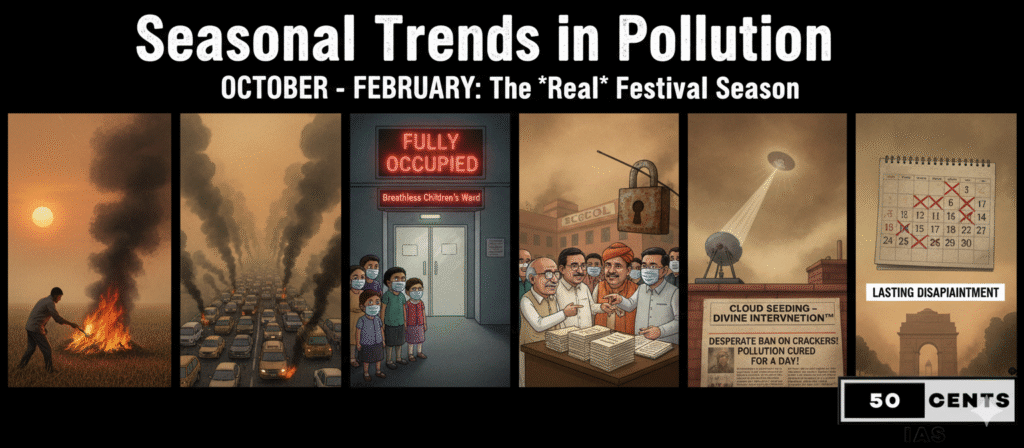
October to February: Delhi's 'Real' festival season of pollution, bringing health crises, closed schools, and endless, often empty, policy promises.
The Trends of Pollution According to the Seasons.
October through the month of February: The pollution festival season. Air becomes poison; hospitals are full of short-brewing children. --Schools are shaken, but the government draws new policy drafts and gives promises every year. Gods pouring, seeding clouds, wretched prohibition,--one can find all this in set-off headlines but always in vain.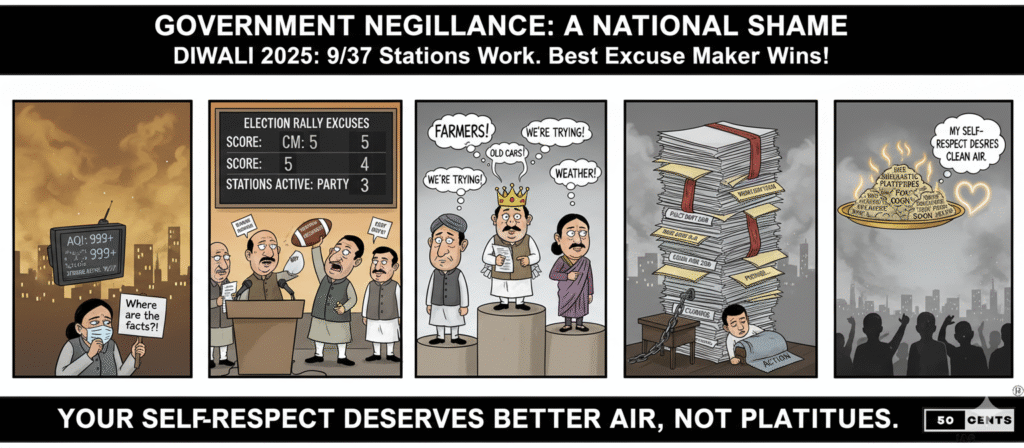
Delhi Air Pollution: Government Negligence continues as monitoring stations fail and excuses fly. Your self-respect deserves better than empty promises.
Supreme Court’s & NGT’s Roles
From the bench the Supreme Court screams, and issues plans of action, and threatens criminal prosecution over stubble burning.The National Green Tribunal (NGT) is attempting to dispense swift justice, claims to clear cases in months and has made landmark decisions against open burning of waste, sanctioning of the guilty, and compensational damages. The work of NGT is genuine, and comedy of jurisdiction and severe lack of resources, it is often the province of red tape to environmental justice in India.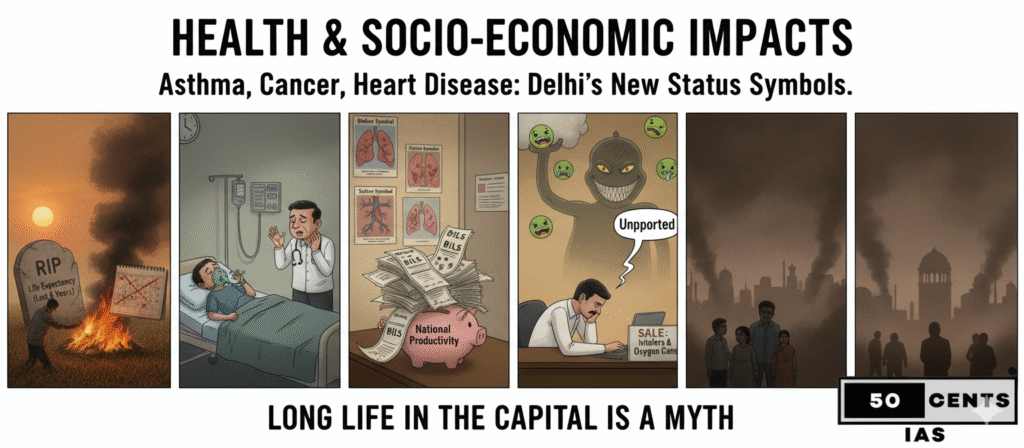
Protest: Distraction or responsibility?
In extreme cases of pollution, it becomes the weapon of the opposition parties. Rather than coming up with constructive solutions, there are those leaders who instigate protests to guarantee the rights of the farmers, yet they are encouraging stubble burning.Instead of providing an answer to the problem, they contribute to the haze of accountability. This inescapable politics is a distraction that puts collective action on its way so as to end the annual gas chamber routine in Delhi.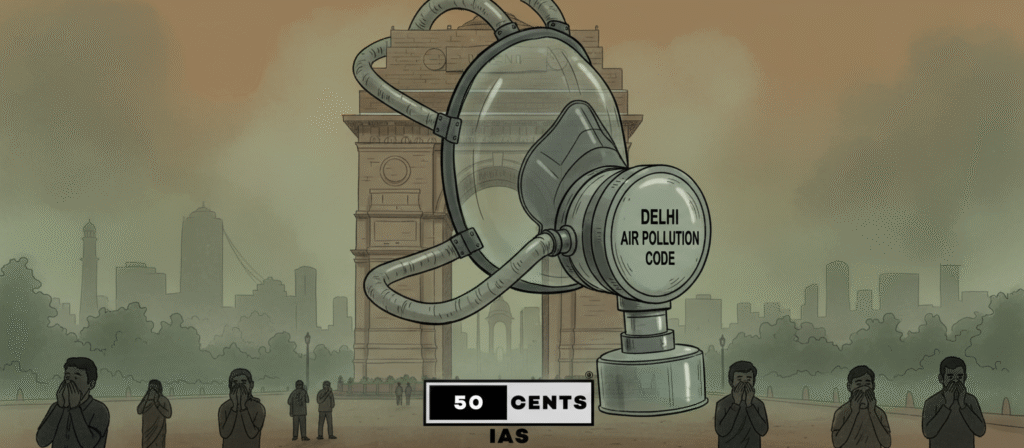
Delhi’s final hope: Only a permanent air pollution code—like this oxygen mask—can rescue the capital. 50-CENTS IAS urges real change over hollow promises. #pollution #Delhi
Permanent Solution: Is a Code Necessary?
Should it be time to call out to a permanent legally binding Delhi Air Pollution Code? Yes. The air of Delhi can be a bargaining point because without systematic laws all year round, by all governments, the air will be at the mercy of politics. An oxygen mask to India, not the piece cloth of temporary prohibition and follow-ups No longer do we need patchwork outlays of Indian bans.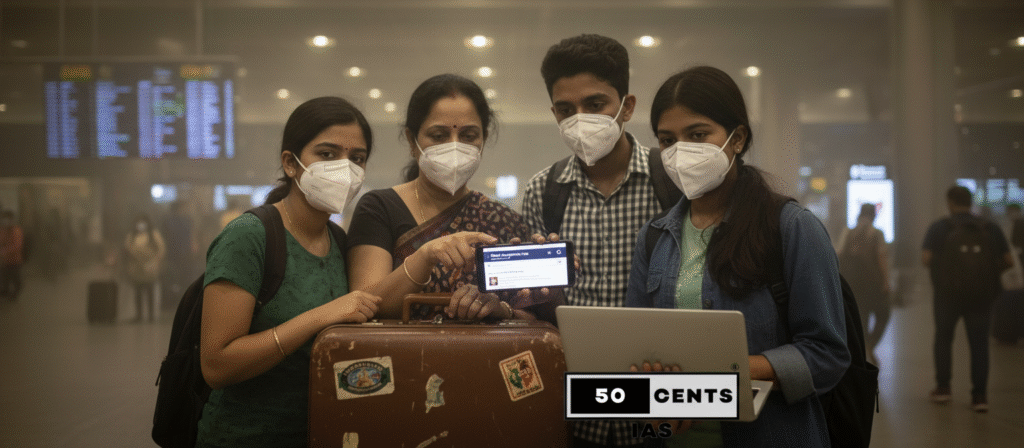
When clean air means leaving home: 50-CENTS IAS mocks the reality of Delhi’s air pollution migration trend. #50centsias
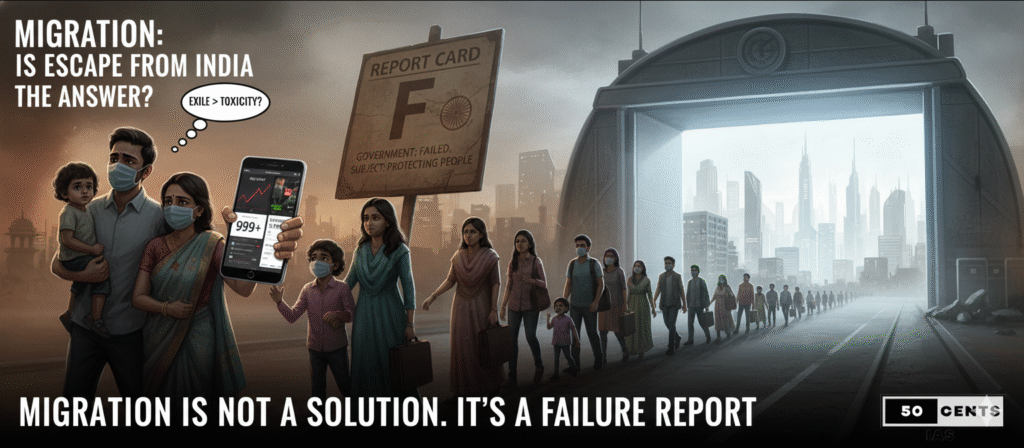
Is a legally binding 'Delhi Air Pollution Code' the permanent solution India desperately needs? Citizens demand action, not just excuses.
Migration: Is Escape out of India the Answer?
It is sad, yet a fact: however, not all educated Delhiites cannot think of leaving India any more. These are the months when every November the emigration websites and foreign job ads trend, and the AQI charts have it. Parents ask themselves whether it is better exiled than subjecting kids to long-term chronic poisoning. Nevertheless, migration is not an answer-it is a report card of failure of a nation, and governments must security their citizens instead of putting them away.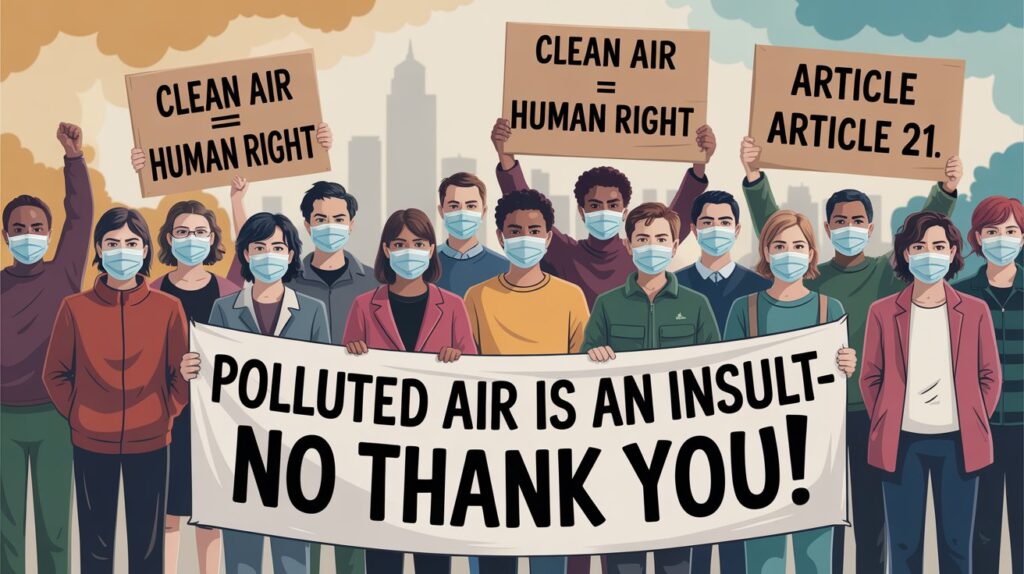
“Polluted air is an insult—No thank you!” Delhi’s citizens unite for dignity and rights, powered by 50-CENTS IAS.
Ordinary Citizens: Excellency, Consciousness, and privileges.
Self-respect? It begins with non-acceptance of bad air as a new reality. The citizens need to insist on the right to clean air which is a human right as stated in Article 21 of the Constitution. Wearing a mask is survival, speaking power. Note: Dignity is given by being aware, not only by complying but also by taking a challenge. Hsap: Polluted air is an impertinence--no thanks! Internal Link: Refer to ‘Civil Society: The Last Hope’ for actionable tips on how you can get involved locally.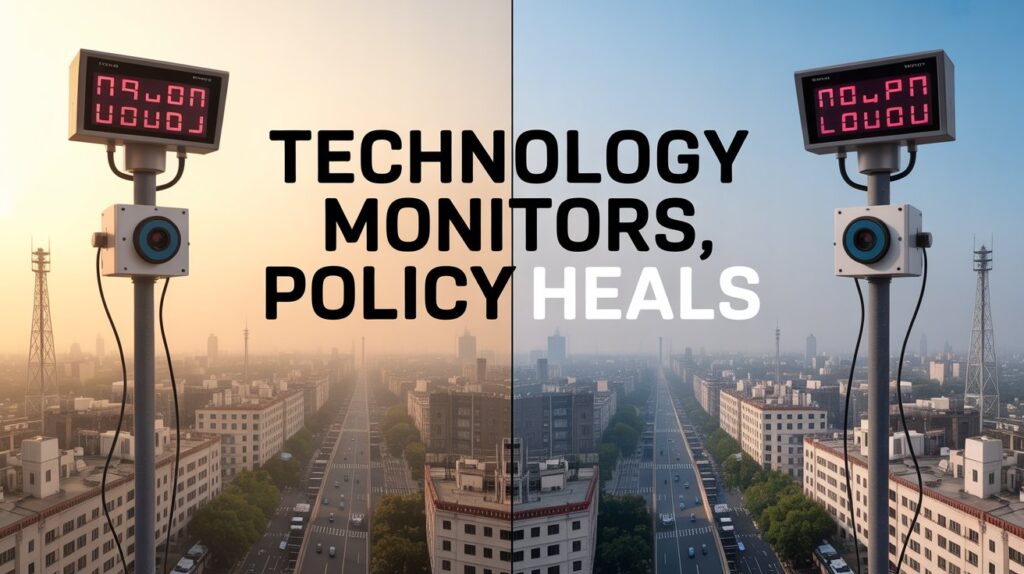
The painful truth: Despite fancy gadgets and AI sensors, Delhi's pollution policy paralysis proves technology can't replace the political will for strict enforcement.
Technology, Policy, Implementation.
Live air quality survey, AI surveillance cameras ANPR cameras- Delhi is technologized but still breathless. Cloud seeding? Simple rain-washing of the problem. The reality: Tech-no-shows do not resolve the issue of policy paralysis. The crisis can be reversed only when solid laws and their strict enforcement are in place supported by smooth coordination (not only by PowerPoint presentations).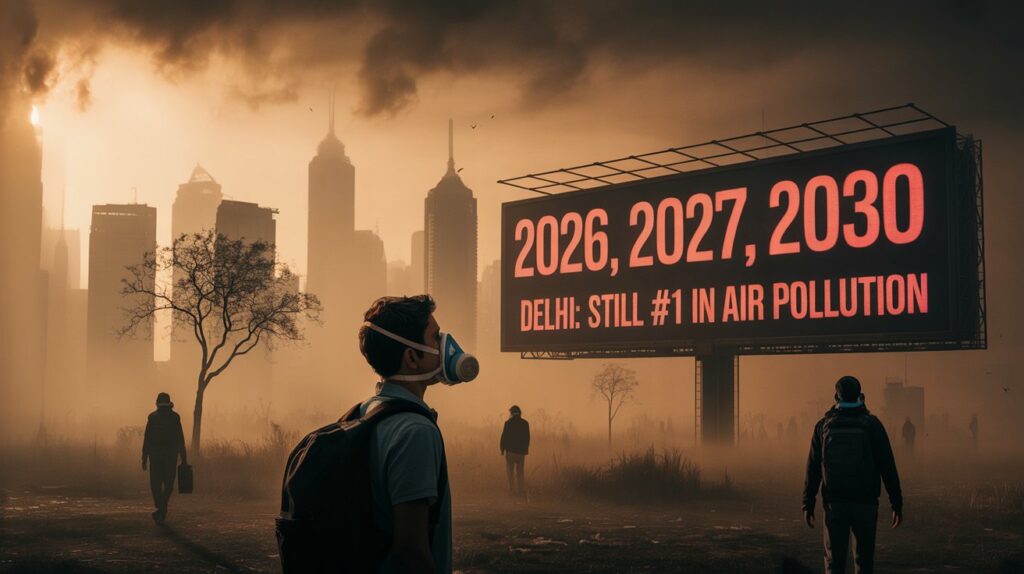
Forecast to 2030: If current trends continue, Delhi's clean air dream remains distant.
Predictions for 2026, 2027, 2030
Prediction:
Delhi is still likely to be on the first place on the list of air pollution in the world in 2030, following the current trends.Until political grandstanding is terminated and pollution control is a national priority, as opposed to transient and regional, clean air will just be a dream.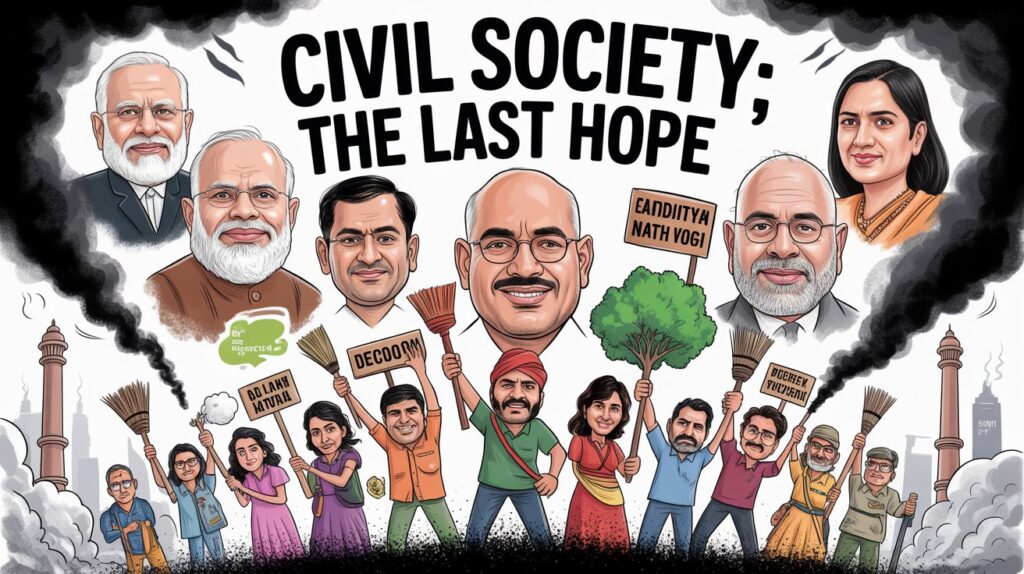
When government fails, civil society fights for Delhi’s right to clean air. Tree by tree, protest by protest—50-CENTS IAS salutes the real leaders.
Civil Society: The Last Hope
There is growing strength of the anti-pollution movement in India by the NGOs, environmental activists, and common citizens.Social mobilization, tree-planting campaigns, demonstrations, legal mobilization campaigns, segregation of wastes, it is the grassroots work that makes leaders deliver. When the government and parties fail, civil society comes in.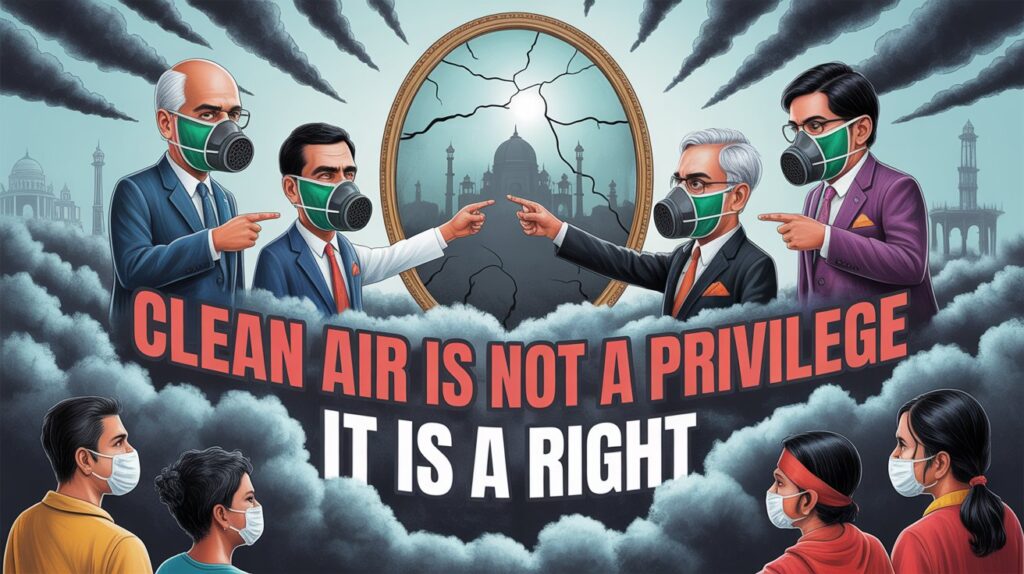
Sarcasm aside—Delhi’s citizens demand clean air as a right, not a privilege. 50-CENTS IAS challenges India to act, not just excuse.
Conclusion: Cynicism, Reality, and an Appeal.
It is not a failure of the government alone in Delhi but it is a challenge to the soul of India. Will we continue to sink in the seas of excuses or are we going to have some self respect? Will they listen to the decision-makers or will citizens still have to wear masks indoors? Make this blog a reflection, a mockery, of what is not effective and Indians will know: Clean air is not a privilege, but a right. Sarcasm is out of the way - Demand, act, Reclaim the breath of Life.There are 20 UPSC-relevant, short, exam-ready, F.A.Q.s on the Delhi air pollution here:
Delhi Air pollution: 20 Frequently asked questions (FAQs) on UPSC (Answers given).
1. What is Air Quality Index (AQI) and how it is gauged in Delhi?
Response: The AQI is a composite index used to understand the levels of air pollution using concentrations of major pollutants such as PM 2.5, PM 10, NO2, SO2, CO and O3 levels. It is checked at various monitoring stations in Delhi by use of digital sensors and classified as Good, Satisfactory, Moderate, Poor, Very Poor and severe.2. Why then does the pollution of the air in Delhi increase during winter?
Explanation: In winter, the lower wind speed and the low temperature cause the temperature inversion, trapping the pollutants near the surface. There is also the contribution of increased burning of crop stubble and the use of firecrackers which are contributing factors to the seasonal spike.3. So what is the source of air pollution in Delhi?
Response: Primarily stubble burns in the adjacent states, traffic emissions, construction dust, release of industrial emissions, open waste burning and unfavorable meteorological conditions.4. What will be the effect of gaddy burning in Punjab and Haryana on The Delhi surroundings?
Explanation: Due to Crop residue burning, smoke and PM2.5 and PM10 are transported due to prevailing winds, thus causing a sudden worsening in the air quality in Delhi in October-November.5. What is the most widespread pollutant of the Delhiian air, and what is the impact?
Response: PM2.5 and PM10 are the most widespread and dangerous and lead to respiratory and cardiovascular diseases. These other pollutants are NO2, SO2, CO, and Ozone that have health and environmental risks.6. How does bad air quality affect the health of the population of Delhi?
Risks augmented among residents as they encounter more threats of asthma, lung cancer, heart, and reduced life span. The pollution in Delhi is estimated to cause a life time of up to 8 years.7. What does the Odd-Even scheme do to decrease the pollution?
Explanation: The Odd-Even plan will limit vehicular traffic by permitting vehicles with odd/even license plates to travel on different days so that the number of vehicles on the roads will be smaller that will result in fewer emissions.8. What has the Supreme Court done concerning the pollution of air in Delhi?
Response: The Supreme Court has imposed prohibitions on stubble burning, controlled construction business, imposed regulations on the use of cleaner fuels, and instructed on the Government to take action plans on the pollution.9. So what is the role of National Green Tribunal (NGT)?
Response: The NGT settles environmental disputes, imposes fines on the pollutants, imposes pollution rates, and checks enforcement in Delhi usually by use of suo motu action and time limited decision.10. What is the Air Pollution mitigation plan 2025 of Delhi?
Response: It is a multi-pronged government policy such as encouraging the use of electric cars, regulating industry, cloud seeding experiments, improving infrastructure, and increasing the severity of pollution regulations.
50-CENTS IAS Institute – Empowering UPSC Aspirants Across India
https://www.youtube.com/watch?v=Z7guCZLoQ-g&t=762s Facebook Twitter Youtube
JuliaSeS
Hello! I sent a request but haven’t received a response yet. Please contact me via WhatsApp or by phone.
wa.me/+79173031189
Vibhuti
Insightful
Fb
Awesome 👍
Sachin Sarkar
Looking ahead to 2026, 2027, and 2030, whether Delhi will breathe clean air depends heavily on sustained enforcement of pollution control measures, ongoing governmental initiatives, and behavioral changes among residents and industries. While current data indicate progress, the air quality remains precarious, and climate factors, urbanization pressure, and regional pollution sources may pose ongoing risks.
RamLal
The Delhi air pollution crisis remains a serious challenge as of late 2025. Despite some improvements in recent years, with data showing a decline in Delhi’s Air Quality Index (AQI) in 2025 compared to previous years, the pollution levels are still predominantly in the “poor” to “very poor” range. For instance, recent AQI readings have fluctuated near or above the 200–300 mark, indicating unhealthy air quality for residents, with certain zones even falling into the “severe” pollution category.
Ritu Ranjan
Superb Blog