Successful Newsletter Launch: What You Need to Know
UPSC Preparation Guide 2025: Top 7 Mistakes.
Table of Contents
Introduction: Unlocking the UPSC Dream
Motivation: Sustaining Your UPSC Journey
2.1 Importance of Purpose and Vision
2.2 Goal-Setting and Discipline
2.3 Overcoming Demotivation
Common Mistakes to Avoid in UPSC Preparation
3.1 Ignoring Syllabus Analysis
3.2 Neglecting Answer Writing Practice
3.3 Poor Time Management and Revision
3.4 Overdependence on Coaching
3.5 Lack of Current Affairs Integration
How to Select the Best Optional Subject for UPSC
4.1 Factors to Consider: Interest, Overlap, and Resources
4.2 Comparative Analysis of Popular Optionals
4.3 Personalisation and Strategy
Why Sociology is a Preferred UPSC Optional
5.1 Compact and Scoring Syllabus
5.2 Overlap with General Studies and Essay
5.3 Interview Advantages
5.4 Toppers’ Insights and Success Stories
Mastering Note-Making Techniques and Templates
7.1 Importance of Note-Making
7.2 Note-Making Methods: Outlining, Cornell, Mind Maps
7.3 Subject-Wise Note Templates
7.4 Newspaper and Current Affairs Notes
7.5 Integrating Digital Tools
7.6 Effective Revision Using Notes
Branding with 50-CENTS IAS Institute
8.1 Institute Overview
8.2 Unique Mentorship and Resources
8.3 Success Stories and Testimonials
Internal and External Linking Strategy for SEO Success
9.1 Best Practices for Internal Linking
9.2 External Authority Linkages
Conclusion: A Journey Beyond Success
The Civil Services journey: An intellectual pilgrimage igniting the spirit of public service. Aspirants and mentors, empowered by the expert guidance of **50-CENTS IAS Institute**, embark on this transformative path towards nation-building.
Introduction: Unlocking the UPSC Dream
The civil services examination is more than an assessment; it is an intellectual pilgrimage imbued with the spirit of public service. Aspirants and diplomats converge on this path with a unified passion to transform India’s governance. This guide—curated by expert mentors at 50-CENTS IAS Institute—offers an up-to-date, value-adding, and humanized approach for contemporary UPSC candidates.
Motivation: Sustaining Your UPSC Journey
The path to civil services is rigorous, demanding sustained intent and clarity of vision. Repeated stories of toppers often echo the same message: intrinsic motivation triumphs over transient inspiration. Ground your journey in national service, and let the stories of luminaries, renowned bureaucrats, and social reformers fuel you in moments of fatigue.
Anchor your preparation in a higher purpose.
Develop daily and long-term goals.
Embrace challenges as formative experiences.
Whenever you falter, remember the transformative potential your actions hold for society’s most marginalized.
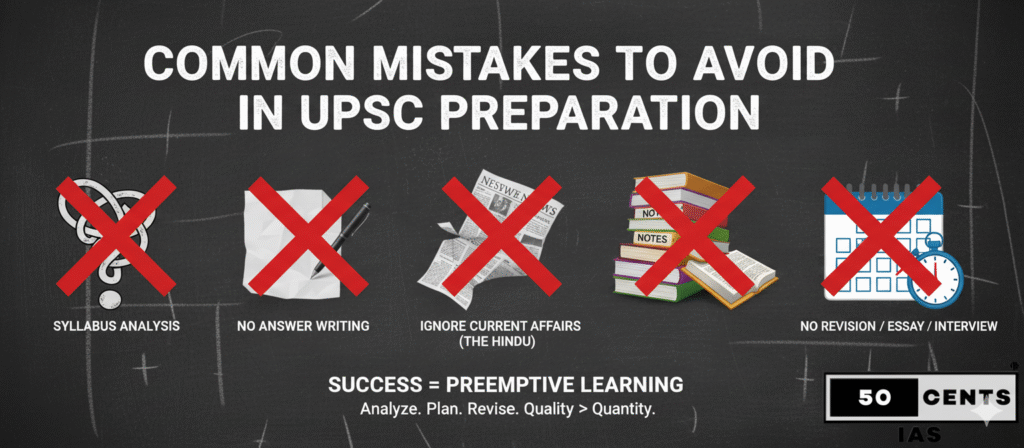
A visually engaging infographic by 50 CENTS IAS outlining key mistakes UPSC aspirants should avoid for success.
Common Mistakes to Avoid in UPSC Preparation
Many talented aspirants falter due to avoidable errors:
Overlooking deep analysis of the UPSC syllabus and trends.
Avoiding answer writing until too late in the process.
Underestimating the value of current affairs—particularly from trusted dailies like The Hindu.
Over-reliance on coaching notes, neglecting NCERT fundamentals.
Neglecting time for revision and for essay/interview practice.
Success comes from preemptively learning from these missteps. Examine last years’ questions, plan your calendar with built-in revision blocks, and remember—quality trumps quantity.
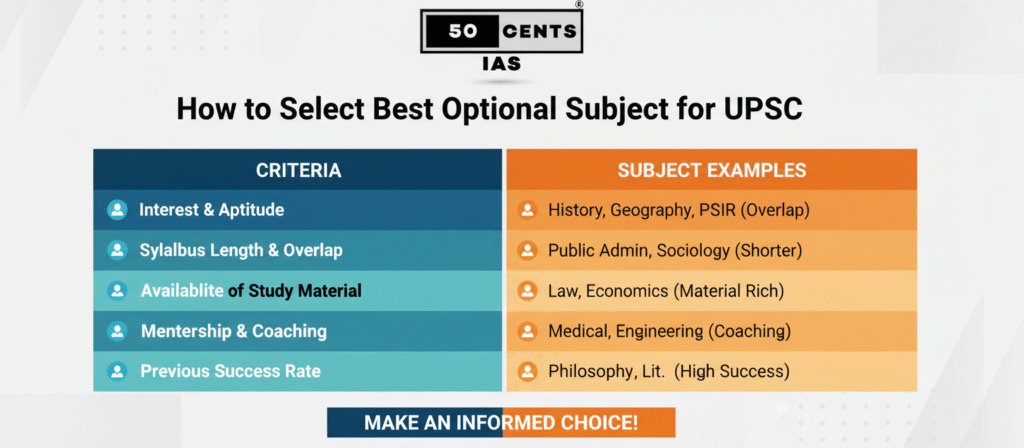
How to Select the Best Optional Subject for UPSC
Your optional is the lever that can change your entire rank. Consider the following:
Interest: Choose a subject you genuinely wish to master.
Academic Background: Utilize your graduation strengths if they overlap.
Scoring Trend & Overlap: Sociology, Public Administration, and Geography provide a strategic edge through overlap with GS and Essay.
Availability of Resources: Confirm that authentic, high-quality materials are accessible—an advantage with classic optionals like Sociology.
Sociology
Syllabus
Overlap
Trend
Concept
Sociology
Short
Very High
Consistent
Clear
Public Admin
Medium
High
Variable
Moderate
Geography
Long
Moderate
Variable
Average
History
Lengthy
Lengthy
Average
Varies
Toppers’ insights repeatedly favor Sociology for its compactness, clarity, and compatibility with dynamic current affairs.
A comprehensive guide by 50 CENTS IAS on choosing the best optional subject for UPSC exams, highlighting factors such as interest, resource availability, and subject overlap.
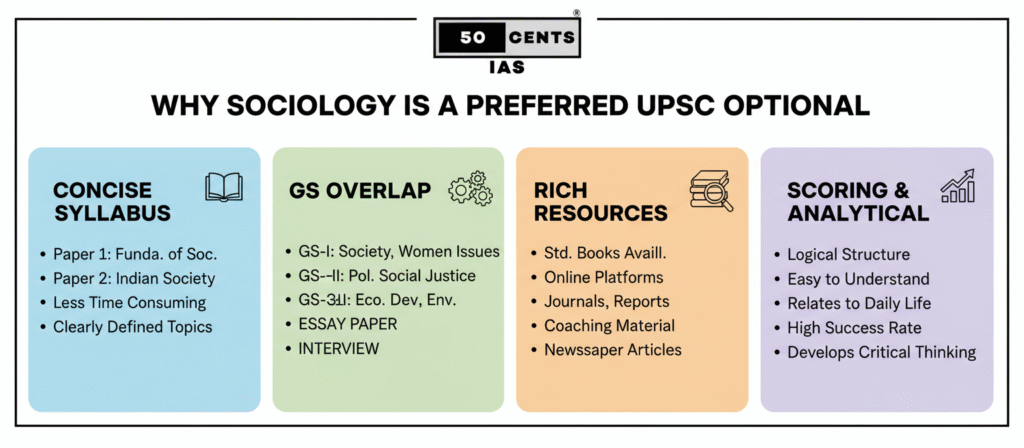
Why Sociology is a Preferred UPSC Optional
Sociology has emerged as the most strategic choice for discerning aspirants:
Concise and Manageable: The syllabus is succinct, making comprehensive coverage and revision feasible.
Objective and Analytical: Answers in Sociology benefit from clarity and current examples, earning higher marks.
GS & Essay Advantage: Themes bridge across GS, Essay, and Interview stages.
Rich Resource Availability: Notes, mentorship, and test series are readily accessible, particularly at leading institutes.
Panel Appreciation: Sociological perspectives demonstrate deep awareness during interviews—an attribute regularly sought by UPSC boards.
Toppers’ stories and mark sheets consistently reveal Sociology’s high yield, especially for those with humanities inclinations.
An educational infographic from 50 CENTS IAS showcasing why Sociology is a strategic choice for UPSC aspirants.
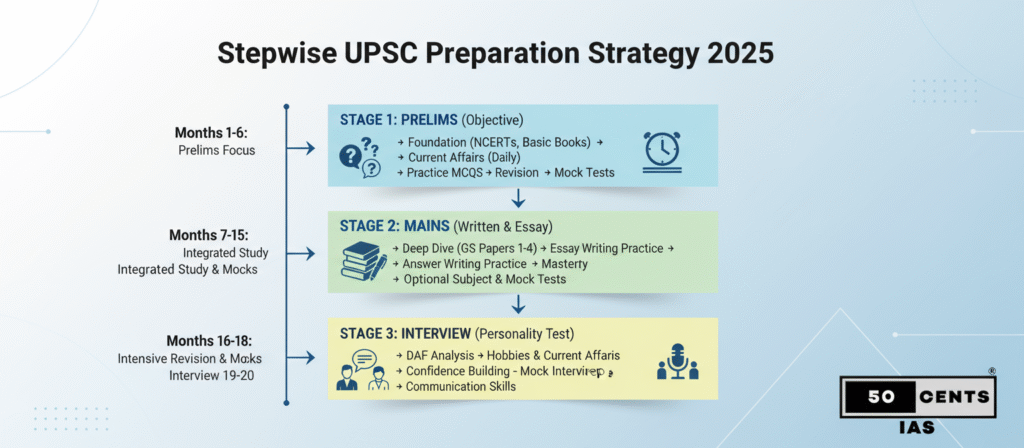
Stepwise UPSC Preparation Strategy for 2025
Prelims
Master the syllabus and prioritize static + dynamic segments.
Practice with daily MCQs and mock tests.
Integrate current affairs from The Hindu, PIB, and Yojana—summarize editorials for revision.
Mains
Regular answer writing: Start with PYQs, integrate multi-dimensional perspectives.
Consolidate value addition with case studies and government schemes.
Time your essay writing sessions—use bullet points and subheadings for clarity.
Interview
Cultivate honesty, clarity, and humility: Panel members look for both knowledge and poise.
Stay updated on socio-political currents—debate regularly within peer groups.
Participate in mock interviews, solicit feedback, and internalize improvements.
A visual guide by 50 CENTS IAS to mastering UPSC preparation in 2025, with segmented tips for prelims, mains, and interview.
Mastering Note-Making Techniques and Templates
Effective note-making is your best investment. Here’s a stepwise approach:
Outlining: Use headings, subheadings, bullet points.
Cornell & Flowcharts: Utilize columns, charts, and mind-maps for complex subjects and current affairs.
Digital Tools: Adopt Notion, OneNote for searchable, updatable resources.
Revision: Schedule regular intervals—weekly and monthly—for revision via notes.
Embrace dynamic note-making: revise and update your notes with every new report, scheme, and editorial
50-CENTS IAS Institute
50-CENTS IAS Institute is the anchor for UPSC aspirants seeking mentorship, resources, and a transformational learning ecosystem:
Personalized guidance from accomplished mentors.
Curated test series, peer group discussions, and resource bank.
Unmatched track record with alumni in top central and state services.
Aspirants at 50-CENTS benefit from exclusive workshops, note banks, and exam simulations, preparing them not only to clear the exam but to lead society.
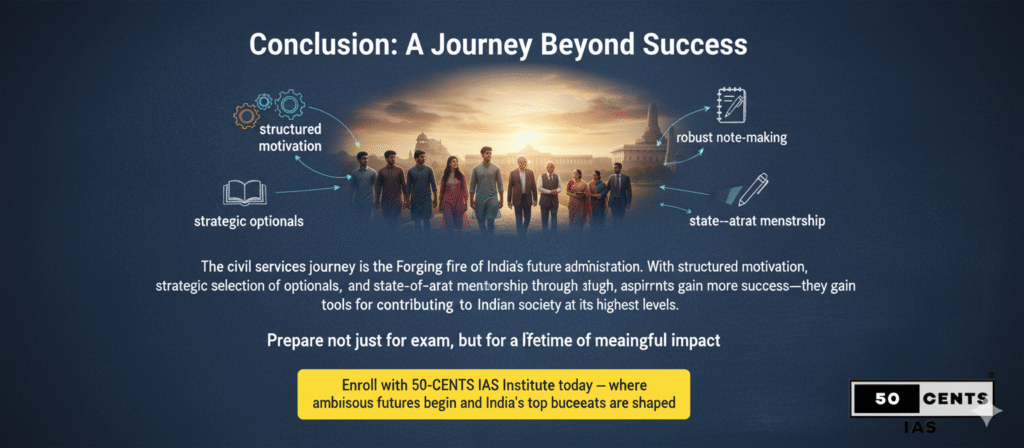
The civil services journey is the forging fire of India's future administration. With structured motivation, strategic selection of optionals, robust note-making, and state-of-the-art mentorship through 50-CENTS IAS Institute, aspirants gain more than exam success—they gain the tools for contributing to Indian society at its highest levels.
Prepare not just for an exam, but for a lifetime of meaningful impact.
Enroll with 50-CENTS IAS Institute today—where ambitious futures begin and India’s top bureaucrats are shaped.
Transformative UPSC journey powered by 50 CENTS IAS—where aspirants become India’s future leaders.
Q1. What is the UPSC Civil Services Examination in 2025?
The UPSC Civil Services Examination 2025 is a national-level competitive exam conducted by the Union Public Service Commission (UPSC) for recruitment into top government services like IAS, IPS, IFS, and others.
Q2. What is the eligibility criteria for UPSC 2025?
Aspirants must have a graduate degree from a recognized university and be aged between 21 and 32 years as of August 1, 2025. Categories like OBC and SC/ST have age relaxations.
Q3. How many attempts are allowed for the UPSC exam?
General category candidates get 6 attempts, OBC 9 attempts, and SC/ST candidates have unlimited attempts within the age limit.
Q4. What is the exam pattern for UPSC 2025?
The UPSC exam has three stages: Prelims (objective), Mains (written), and Interview (personality test).
Q5. Is there negative marking in UPSC Prelims?
Yes, there is a 1/3 negative marking for each wrong answer in both GS Paper I and CSAT (Paper II) in the Prelims.
Q6. Can I write UPSC mains in Hindi?
Yes, candidates can write the UPSC Mains examination in Hindi as well as several other Indian languages, as notified.
Q7. What is the syllabus for UPSC Prelims 2025?
Prelims covers General Studies (GS) Paper I and CSAT (General Studies Paper II), testing current affairs, history, polity, geography, economy, environment, and aptitude.
Q8. How should I start my UPSC preparation in 2025?
Begin with the UPSC syllabus, read NCERT books, follow The Hindu, and practice previous years’ question papers for a solid foundation.
Q9. How do I choose the best optional subject for UPSC?
Choose based on your graduation subject, personal interest, success trends, and resource availability. Sociology is a top choice for its compact syllabus and high scoring potential.
Q10. What are the important books for UPSC preparation?
Start with NCERTs, then move to standard texts like Laxmikanth for Polity, Spectrum for History, GC Leong for Geography, and Economic Survey and Budget documents.
Q11. When will UPSC 2025 notification be released?
The official notification for UPSC 2025 is expected on January 22, 2025, as per the UPSC calendar.
Q12. Can final year students apply for UPSC 2025?
Yes, final year graduate students can apply, but they must provide proof of passing before the Mains examination.
Q13. What is the role of current affairs in UPSC 2025?
Current affairs are crucial for all UPSC stages. Regularly follow reputed newspapers like The Hindu and supplement with magazines and government sources.
Q14. What happens if I miss appearing after applying for UPSC Prelims?
An attempt is counted only if you appear for the Prelims exam, not just if you fill out the form.
Q15. Is coaching required to crack UPSC 2025?
Coaching can provide guidance, resources, and test series but is not mandatory. Many aspirants succeed through self-study and peer learning.
Q16. Are there any minimum qualifying marks in Mains papers?
You need at least 25% in both language papers (Paper A and B); all GS, Essay, and Optional papers count towards your merit ranking.
Q17. How long does it take to prepare for UPSC?
A focused preparation of one year is generally sufficient for most aspirants, but depends on your background, consistency, and strategy.
Q18. How is the UPSC Interview conducted?
The final stage—the Personality Test—is a 275-mark interview held at the UPSC office. It assesses your knowledge, attitude, and suitability for administration.
Q19. Where can I check UPSC results and cut-off marks?
Results and cut-offs are published on the official UPSC website: upsc.gov.in.
Q20. Which optional subject has the highest success rate in UPSC 2025?
Success rates depend on selection and scoring trends. Sociology, Geography, and Public Administration have traditionally shown strong performance, with Sociology increasingly popular in recent years.
https://youtu.be/CJbZzQgaYoQ
Facebook
Twitter
Youtube
 50-CENTS | An IAS Institute.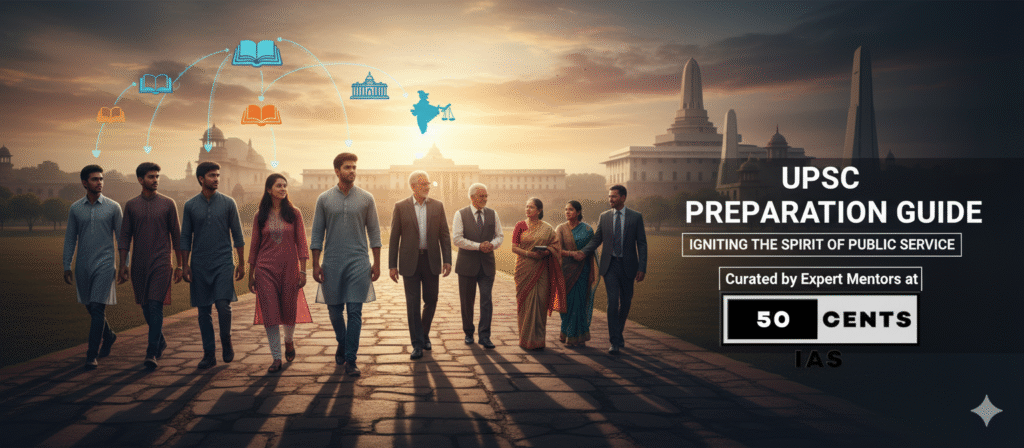
0 Comments