 50-CENTS | An IAS Institute.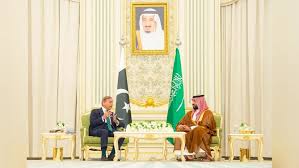
Introduction
Later in September 2025, Pakistan and Saudi Arabia signed a Strategic Mutual Defence Agreement (SMDA) in Riyadh. The agreement outlined that any external aggression of either country would be seen as an aggression on both countries and hence both parties to respond collectively.
Though military alliances are not a novel occurrence in West Asia, this accord is particularly important due to the opportune nature of the time, the unstable security situation in South Asia and the Gulf and the possible effect it may have on the strategic interests of India. To the aspirants of the UPSC, this has to be examined in several ways, such as foreign policy, theories of international relations, issues of national security in India, Middle East geopolitics, energy insecurity, the issue of diaspora, and realignment of powers in the world.
The article provides an in-depth discussion of the problem, focusing on serious UPSC candidates of 8000 words.
- Pakistan–Saudi Relationship (History)
- Affinity, Religious and Ideological
- Pakistan, being an Islamic Republic, has always been under the guardianship of Saudi Arabia in terms of taking care of sacred Islamic locations.
- Bilateral relations have long been influenced by religious legitimacy and soft power.
- Economic and Labour Ties
- Over 2.7 million Pakistani workers reside in Saudi Arabia, sending back billions of dollars every year.
- Pakistan is heavily dependent on Saudi oil supplies.
- Defence and Military Cooperation
- Pakistan has been training Saudi military forces since the 1960s.
- Saudi Arabia has hosted Pakistani troops on several occasions.
- Saudi Arabia has provided financial bailouts to Pakistan during economic downturns.
- Strategic Dependence
- Pakistan’s reliance on Saudi loans, oil, and political support in multilateral forums continues to shape the relationship.
- Affinity, Religious and Ideological
- Characteristics of the 2025 Strategic Mutual Defence Agreement (SMDA)
- Joint Defence Clause: An attack on one is considered an attack on both.
- Scope: Includes land, air, maritime, and cyber domains.
- Joint Training & Exercises: More bilateral training, intelligence sharing, and defence technology transfer.
- Strategic Communication: Establishment of a high-level Defence Council for coordinated responses.
- Symbolism: Signals closer Riyadh–Islamabad defence ties to Iran, Israel, and India.
- International Relations Theoretical Frameworks
- Realism:
- States seek power for survival.
- Pakistan seeks security against India; Saudi Arabia seeks security in regional conflicts (Iran, Israel, Yemen).
- Balance of Power:
- Agreement seen as a counter to Iran.
- Hedge against declining U.S. security guarantees.
- Liberal Institutionalism:
- A bilateral pact instead of a multilateral one.
- Higher escalation risks due to weak institutional checks.
- Constructivism:
- Shared Islamic identity and narratives of unity support the pact.
- Realism:
- Why Now? Geopolitical Timing
- Middle East Flux
- Israeli aggression post-Gaza war.
- Iran’s rising proxy influence in Iraq, Syria, Lebanon, and Yemen.
- U.S. retrenchment.
- Pakistan’s Strategic Needs
- Border tensions with India & Afghanistan.
- Weak economy; dependent on Saudi assistance.
- Military seeks external assurances.
- Saudi Calculations
- Diversifying security partners beyond the U.S.
- Countering Iranian influence.
- Pakistan’s manpower provides military insurance.
- Middle East Flux
- Regional Security Architecture Implications
- For South Asia
- India–Pakistan Dynamics
- Pakistan gains confidence through Saudi support.
- Potential escalation on LoC/Kashmir.
- India must factor Gulf politics into Pakistan policy.
- Afghanistan Factor: Saudi involvement may impact Taliban–Pakistan dynamics.
- India–Pakistan Dynamics
- For West Asia
- Saudi–Iran Rivalry: Indicates Riyadh moving away from Tehran despite détente.
- Arab Security Alliances: Pressure on other GCC states to align with Riyadh.
- For India
- Energy Security: Risk of politicisation of strategic oil supplies from Saudi Arabia.
- Diaspora Risks: Over 9 million Indians in the Gulf face potential instability.
- Diplomatic Balancing: India must maintain ties with Saudi while managing relations with Iran.
- Defense Posture: Possible recalibration of India’s Western Command; enhanced Arabian Sea surveillance.
- For Global Powers
- United States: Perception of declining reliability; concerns about Saudi tilt toward China–Pakistan.
- China: Gains leverage due to ties with both states; boosts Belt & Road security presence.
- Russia: Opportunity to sell weapons and strengthen Middle East presence.
- For South Asia
- India’s Response
- Official Reaction:
- Cautious monitoring; emphasises strong bilateral ties with Saudi Arabia.
- Avoids confrontation.
- Strategic Options:
- Deepen relations with UAE, Oman, Qatar.
- Expand engagement with Iran and Central Asia.
- Strengthen defence ties with U.S., France, Japan in the Indian Ocean.
- Official Reaction:
- Implications for Domestic Policy
- Greater emphasis on defence indigenisation.
- Balancing diaspora welfare with strategic diplomacy.
Comparative Case Studies
- U.S.–Japan Security Treaty (1951, revised 1960): Similar “mutual defense” concept, but asymmetrical.
- NATO Article 5: Collective defence principle.
- India’s Non-Alignment: India historically avoided such binding alliances, preferring strategic autonomy.
Challenges for Pakistan and Saudi Arabia
- Asymmetry of Power: Saudi wealth vs Pakistan manpower.
- Over-commitment: Pakistan is already overstretched militarily.
- Regional Blowback: Iran, Turkey, Qatar may oppose.
- Sustainability: Economic fragility may limit operationalisation.
Way Forward for India
- Diplomatic Outreach:
- Increase high-level visits to Saudi Arabia.
- Highlight mutual energy and investment stakes.
- Strategic Communication:
- Project India as a stable partner vis-à-vis volatile Pakistan.
- Military Preparedness:
- Invest in maritime security in the Arabian Sea.
- Joint exercises with Gulf navies.
- Diaspora Protection Policy:
- Clear evacuation and contingency planning.
Relevance for UPSC
- GS II: India and its neighbourhood, implications of regional arrangements on the interests of India.
- GS III: defence preparedness, security challenges, maritime security.
- Essay: Security Alliances and Future of Strategic Autonomy in Asia.
- Ethics: Diaspora safety, foreign policy morality.
Model UPSC Questions
Mains
- Assess the effect of the Pakistan-Saudi Arabia Strategic Defence Agreement on the Indian foreign policy in West Asia.
- Security alliances are a two-edged sword to stability in the region. Speak with regard to the recent events in South Asia and West Asia.
- What role does the policy of strategic autonomy by India encounter problems relating to the changing defence associations in its extended neighbourhood?
Prelims
- Qs based on the location of GCC, Strait of Hormuz, and Arabian Sea chokepoints.
- Recent developments on significant defence agreements.
Conclusion
The Strategic Mutual Defence Agreement between Pakistan and Saudi Arabia has added more ambiguity to the already delicate security grid in South Asia and West Asia. In the case of India, it is how it can reconcile its strong economic relationship with Riyadh and protect its security interests against a Pakistan that is empowered by Saudi support.
The evolution depicts how the multipolar world order is fluid in alliances. To the aspirants of UPSC, it acts like a wake-up call that international relations is not all theory, but how changing alliances directly impact the security, economy and diplomacy of India.
0 Comments