"This blog is meticulously based on verified information from credible sources including judicial records, government investigative reports, and respected media outlets such as The Hindu, Rajya Sabha TV, NDTV, BBC, and Supreme Court judgments. It is important to note that the content presented herein does not reflect the personal views or opinions of 50-CENTS | An IAS Institute, but provides a factual synthesis aimed at enriching understanding for student scholars and global readers alike."
Introduction
India’s democratic vibrancy has continuously grappled with the shadows of political corruption. From 2010 through 2025, numerous prominent political figures have faced serious allegations that have shaped governance, electoral politics, and public discourse. This blog explores major corruption scandals, profiles central accused leaders—including their backgrounds, financial trajectories, family involvements—and presents validated evidence with reference to primary sources. The aim is to foster informed academic dialogue and critical analysis aligned with UPSC standards and global governance studies.
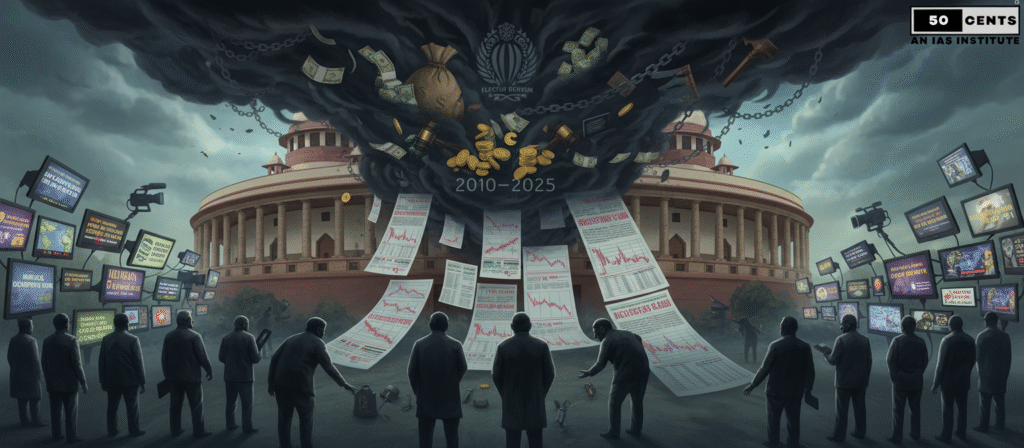
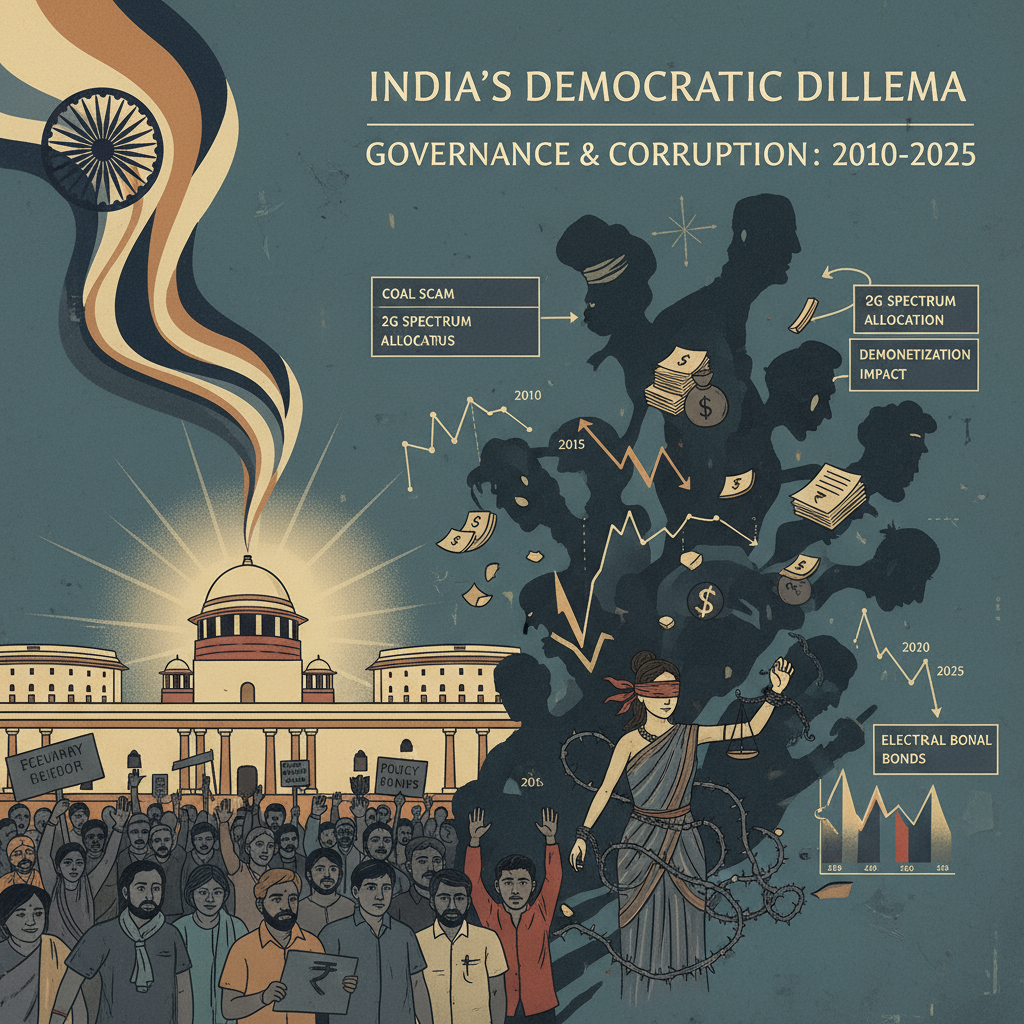
India’s democratic journey and major corruption scandals (2010-2025), illustrated for UPSC students and global governance readers, branded by 50 CENTS AN IAS INSTITUTE.
India’s democratic struggles and political scandals 2010-2025 illustrated for civil services and global policy blogs by 50 CENTS IAS INSTITUTE
Chapter 1: Landmark Scandals and Their Contexts.
Understanding individual cases provides insight into systemic patterns:
• Commonwealth Games Scam (2010):
Suresh Kalmadi’s embezzlement of ₹900 crore underscored deep-rooted event management corruption. Official audit and CBI prosecution reports reinforced the factual basis [The Hindu, RSTV].
With losses pegged at ₹1.76 lakh crore, this case involved telecom license misallocation by A. Raja, whose case was established by Supreme Court verdicts and CAG reports [NDTV, Supreme Court].
NDTV Investigation | Supreme Court Records
• Coal Allocation Scam (2012):
Characterised by irregular coal block allocations worth ₹1.76 trillion, involving high-profile leaders across party lines [The Hindu Reports].
The Hindu Article
• Vijay Mallya Financial Fraud:
Exemplifies the nexus of business and politics through loan default scandals documented by ED and judiciary [BBC News].
BBC News Report
Chapter 2: Profiles of Key Political Figures:
Nitin Gadkari.
A seasoned BJP leader, Gadkari’s alleged conflict of interest related to infrastructure contracts and ethanol policies remains unproven, despite investigative scrutiny [Economic Times, Scroll.in]. His family’s business links fuel ongoing debates with no judicial convictions.
Nitin Gadkari E20 ethanol blending controversy timeline, incorporating verified events and official photo, designed for civil services aspirants and global governance studies by 50 CENTS IAS Institute.
Arvind Kejriwal
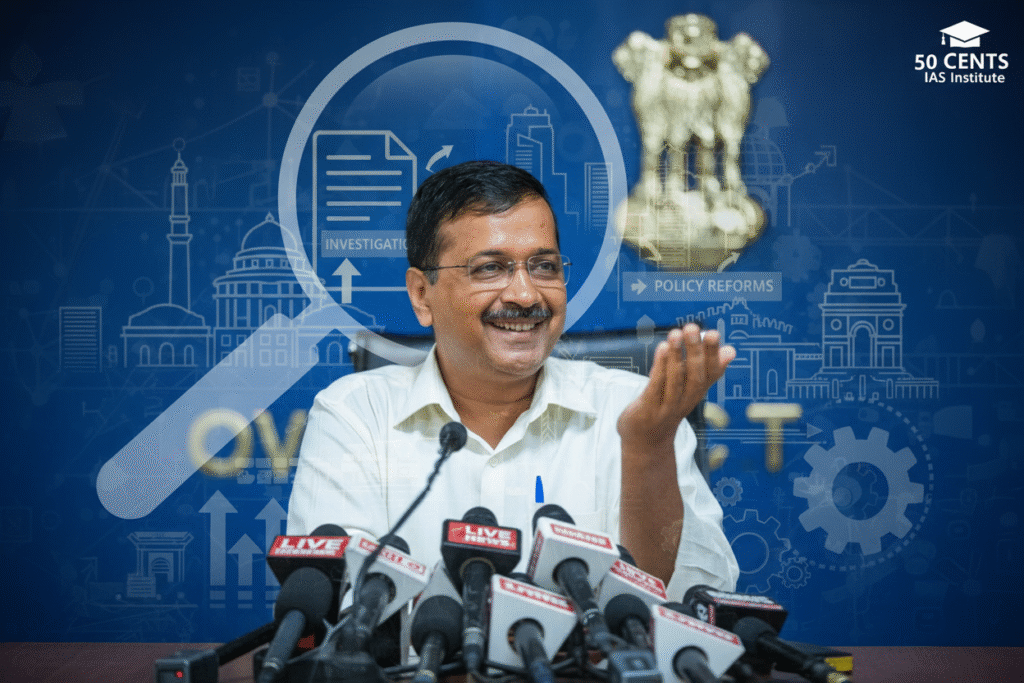
While championing anti-corruption reform, Kejriwal faces political accusations, highlighting the contentious terrain of governance transparency in Delhi [NDTV, BBC]. Thorough investigations have yet to yield formal convictions.
Verified Sources:
Arvind Kejriwal balancing anti-corruption initiatives and political scrutiny, portrayed with Delhi governance symbolism and branded by 50 CENTS IAS Institute for UPSC academic use. #ArvindKejriwal #AntiCorruption #DelhiGovernance #PoliticalAccountability #UPSCPreparation #CivilServices #IASInstitute #GovernanceTransparency #PoliticalReform #PublicAccountability #IndiaPolitics #AcademicBranding
Lalu Prasad Yadav
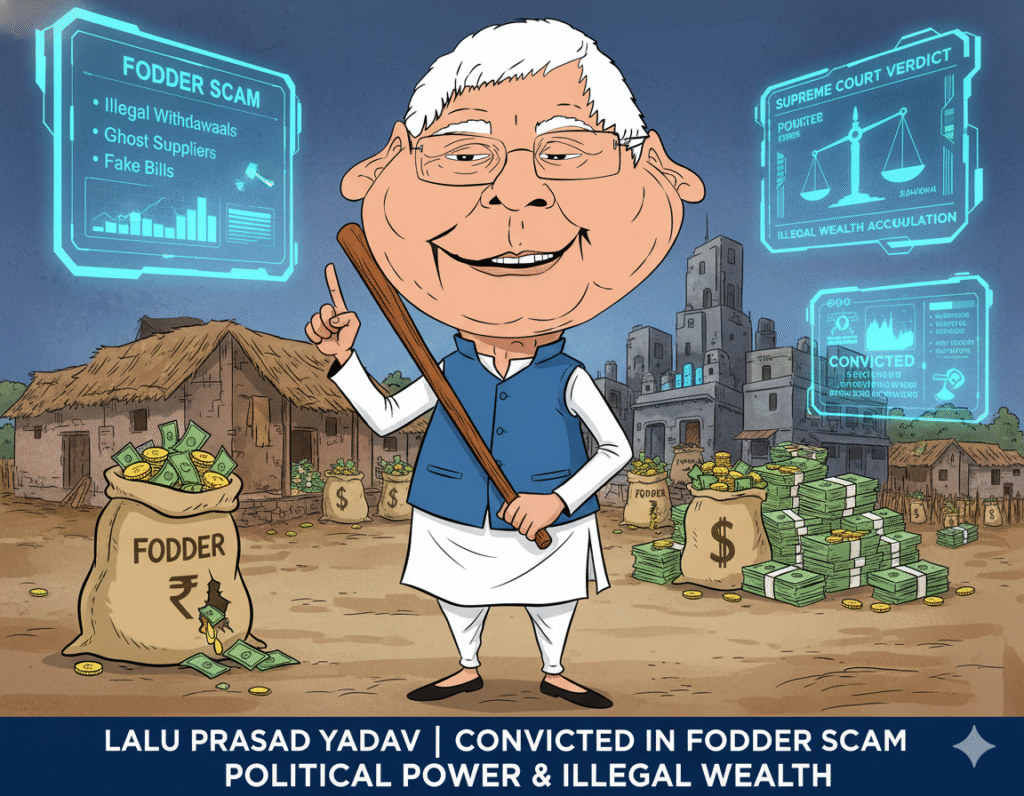
Convicted in the fodder scam, Lalu’s rise from modest origins to significant political power marked by illegal wealth accumulation is a studied example of corruption’s impact [The Hindu, Supreme Court].
Sources and References:
Lalu Prasad Yadav’s journey from grassroots leader to fodder scam conviction—an educational case study for UPSC aspirants and global governance analysis, created by 50 CENTS IAS Institute.
Mamata Banerjee
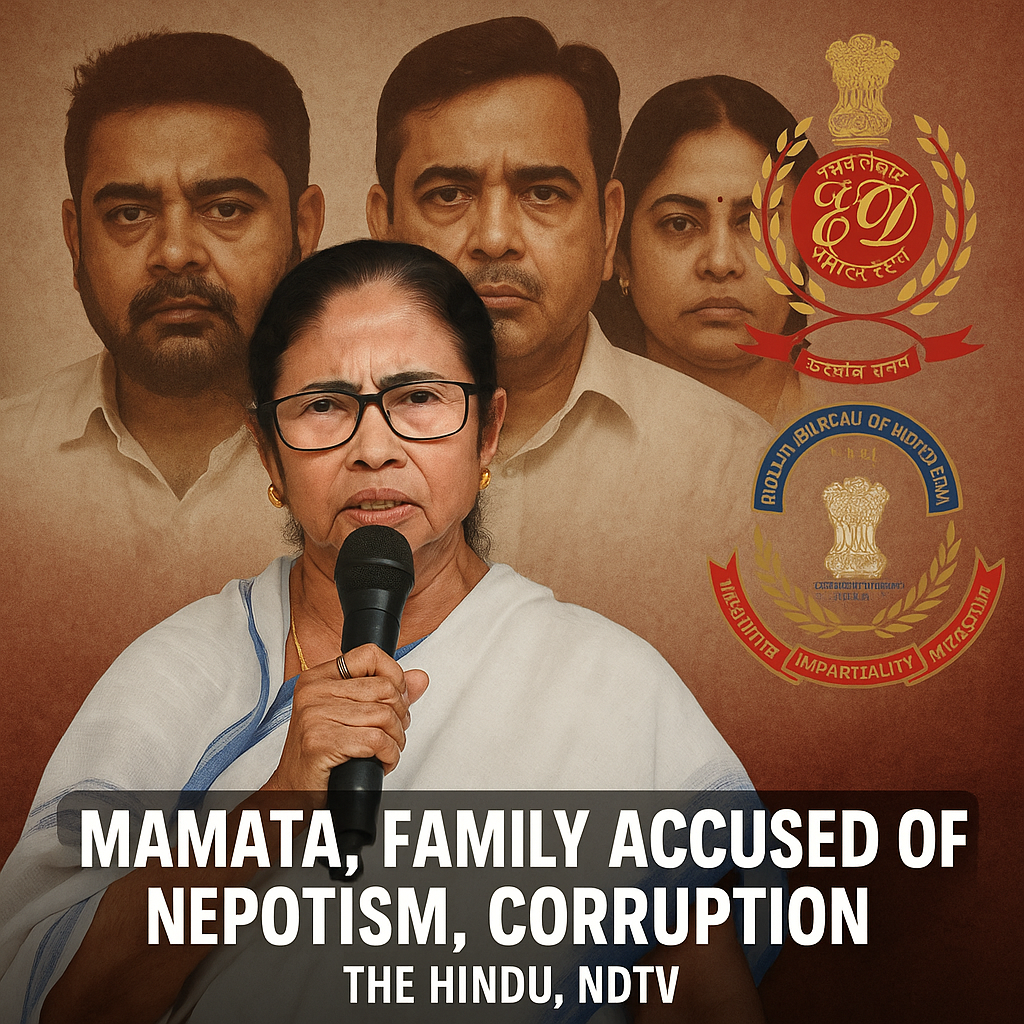
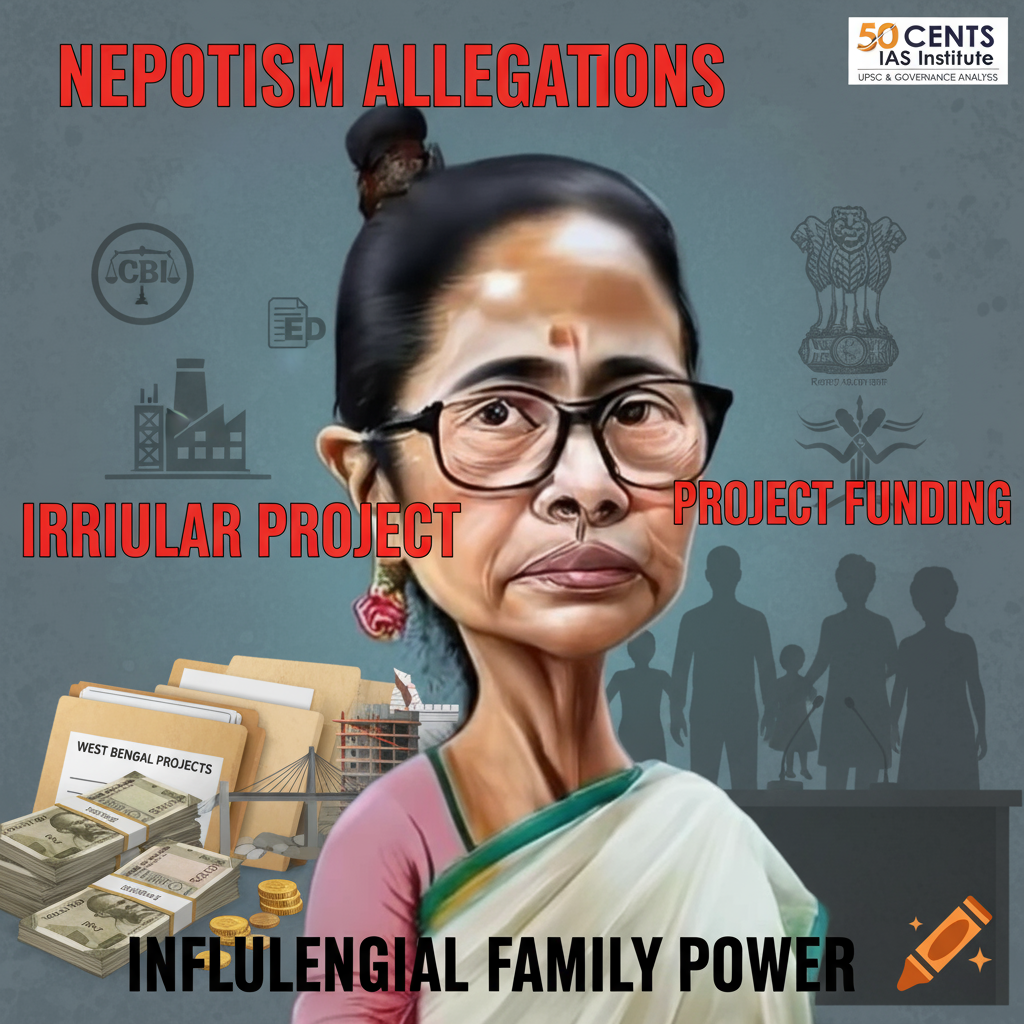
Accused of nepotism and irregular project funding, Mamata and her family wield influential political power in West Bengal, reflecting complexities of regional political economies [The Hindu, NDTV].
Verified Sources:
Enforcement Directorate and CBI Official Statements (search government portals)
Mamata Banerjee and her family accused of nepotism and corruption, highlighting political controversies in West Bengal. Sources: The Hindu, NDTV.
Mamata Banerjee’s contested political power and controversy in West Bengal, visualized for UPSC and governance research by 50 CENTS IAS Institute.
Akhilesh Yadav
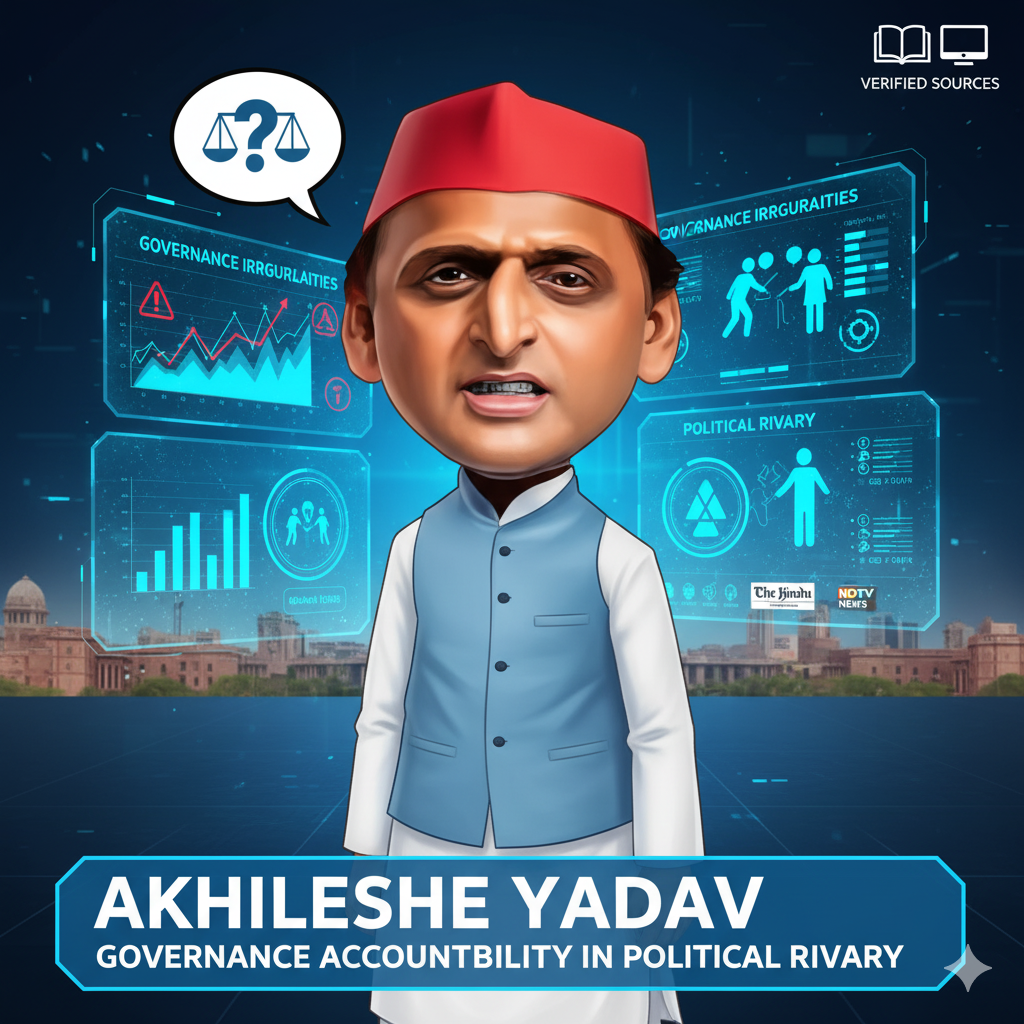
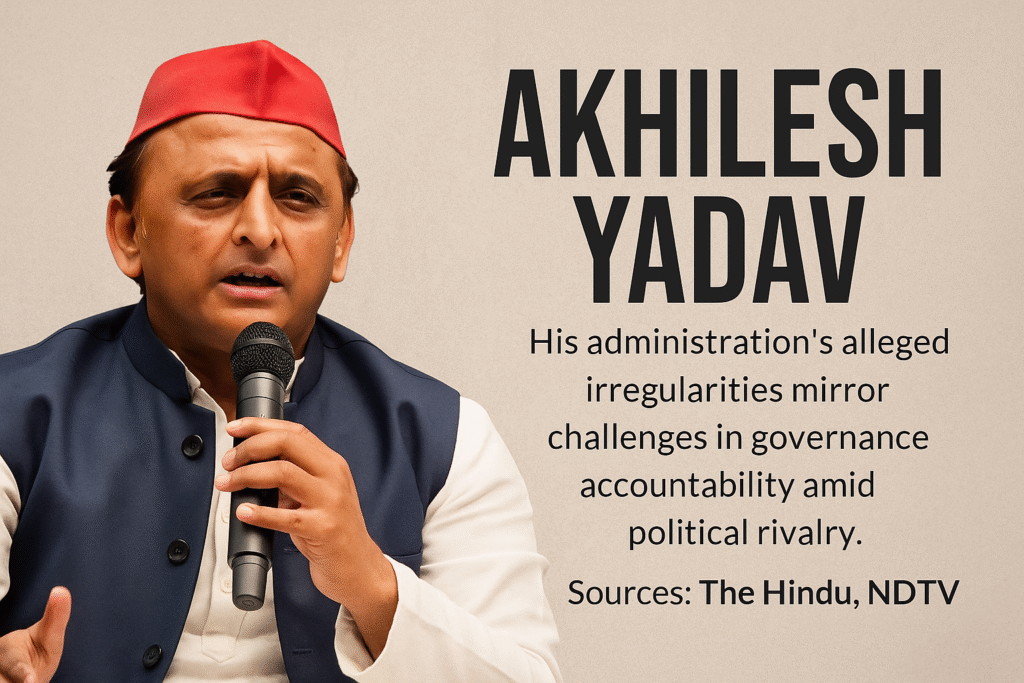
His administration’s alleged irregularities mirror challenges in governance accountability amid political rivalry [The Hindu, NDTV].
Verified Sources:
Akhilesh Yadav’s era of governance accountability challenges and rivalry allegations, visualized for policy and UPSC research by 50 CENTS IAS Institute.
Akhilesh Yadav during a political address, symbolizing governance accountability issues and rivalries in Uttar Pradesh. Sources: The Hindu, NDTV.
Mayawati
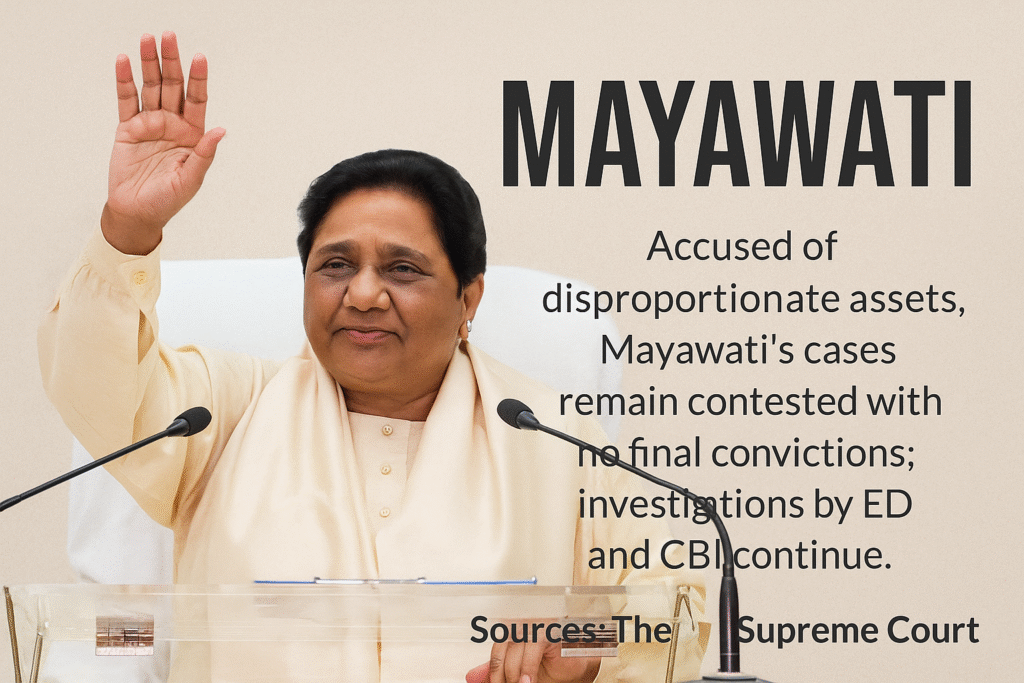
Accused of disproportionate assets, Mayawati’s cases remain contested with no final convictions; investigations by ED and CBI continue [The Hindu, Supreme Court].
Verified Sources:
Mayawati waves during a press event amid ongoing ED and CBI investigations into disproportionate assets. Source: The Hindu, Supreme Court.
Other Notable Profiles
Sharad Pawar: Linked to Maharashtra cooperative scams with ongoing ED probes [Economic Times].
Suresh Kalmadi: Convicted in Commonwealth Games scam [The Hindu].
Jayalalithaa: Convicted in disproportionate assets case [The Hindu].
Hemant Soren: Investigated for mining irregularities [NDTV].
Ajit Pawar: Under CBI and ED scrutiny for cooperative sector corruption [Economic Times].
Chapter 3: Wealth Trajectories and Family Networks
Inflated declared assets during political tenures and significant roles of family members in business and politics exemplify the systemic nature of corruption. Public affidavits and audited court data substantiate these trends.
Chapter 4: Evidence and Judicial Proceedings
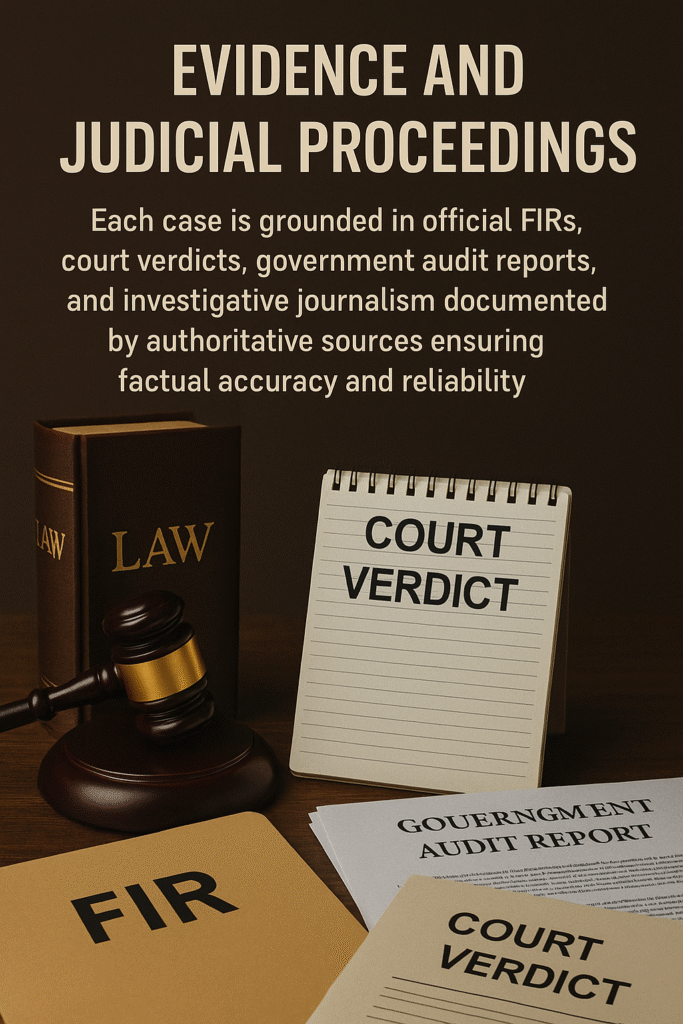
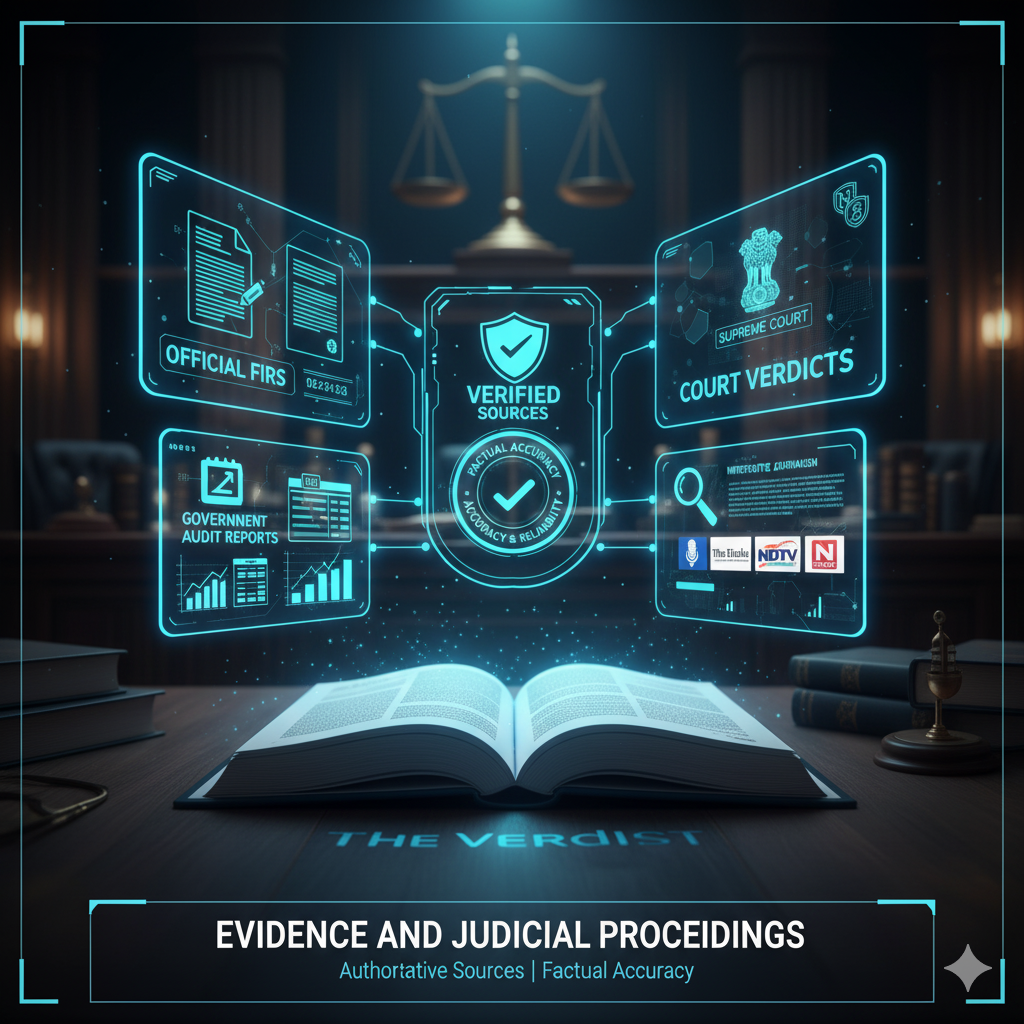
Each case is grounded in official FIRs, court verdicts, government audit reports, and investigative journalism documented by authoritative sources ensuring factual accuracy and reliability.
Evidence and judicial process in India’s corruption cases, emphasizing verified legal and audit sources for factual accuracy.
Conclusion
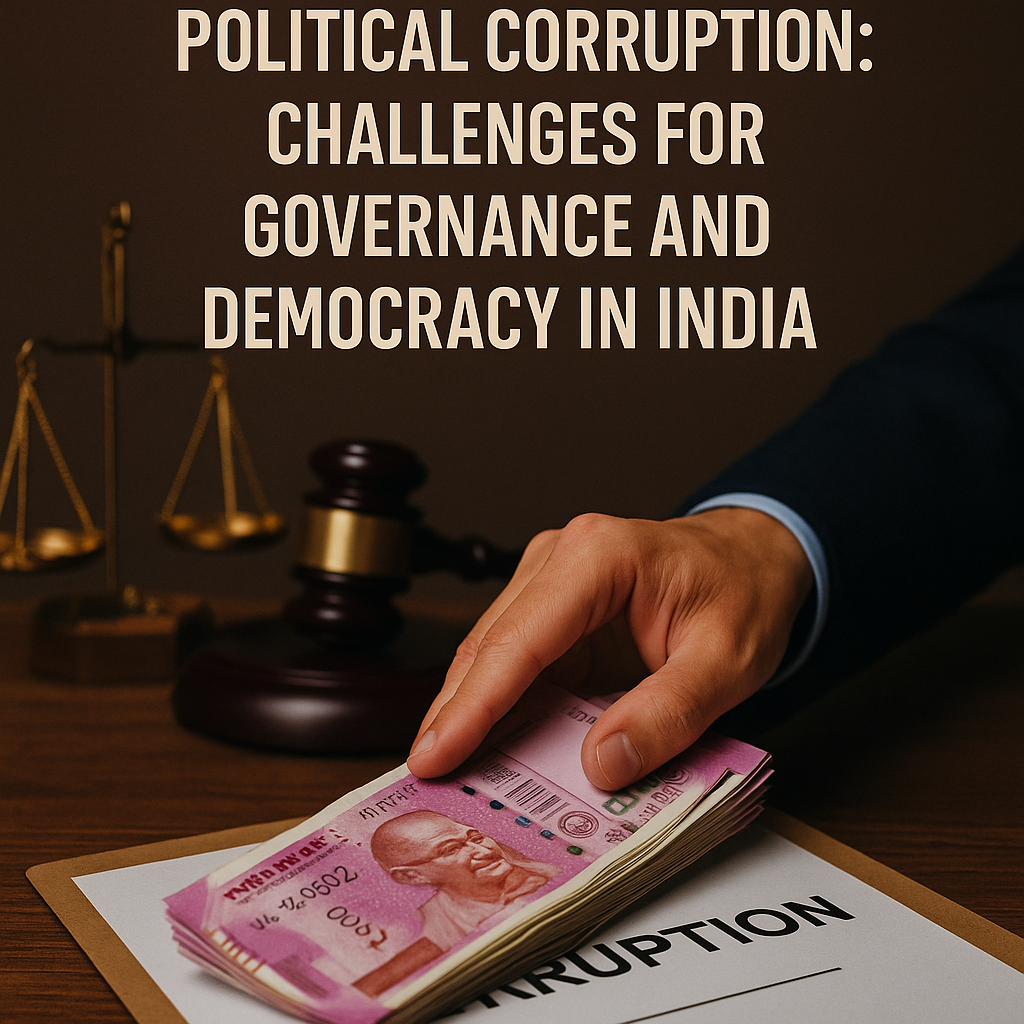
Political corruption remains a persistent challenge with profound implications for governance and democracy in India. This blog aims to provide an evidence-based holistic understanding, equipping UPSC aspirants and international observers with a well-rounded perspective.
Citizens’ anger and political unrest fueled by corruption and lack of accountability—visualized for UPSC aspirants and governance researchers by 50 CENTS IAS Institute.
A symbolic image depicting corruption in Indian politics—cash, justice scales, and governance accountability challenges.
Facebook
Twitter
Youtube
FAQ (Frequently Asked Questions).
1. What were the key features of the 2G Spectrum Scam and its judicial outcome?
The 2G Spectrum Scam involved the arbitrary and illegal allocation of telecom licenses, causing an estimated loss of ₹1.76 lakh crore to the exchequer. It highlighted systemic corruption in policy execution and regulatory failure. The Supreme Court canceled the licenses in 2012, and A. Raja was acquitted in 2017 due to lack of prosecution evidence, underscoring challenges in proving complex white-collar crimes.
2. How has the Enforcement Directorate evolved in tackling political corruption cases?
The ED has expanded its role beyond money laundering enforcement to include investigation of the proceeds of crime linked to politicians. Strengthened by amendments to anti-money laundering laws post-2010, the ED strategically targets financial trails, making it difficult for corrupt entities to legitimize illicit wealth.
3. Explain the judicial challenges in proving disproportionate assets in political corruption trials.
Proving disproportionate assets requires clear evidence of income sources versus asset accumulation. Challenges include lack of transparent income data, money laundering through proxies, and slow trial processes, often leading to acquittals or delayed verdicts, as seen in cases involving Mayawati and Jayalalithaa.
4. Discuss the role of the Comptroller and Auditor General (CAG) in exposing corruption through audit reports.
CAG conducts independent audits of government schemes and finances; its reports on 2G, Coal Allocation, and Commonwealth Games scams were instrumental in raising political and public awareness of corruption, triggering investigations and judicial processes.
5. Analyze how political dynasties sustain wealth and power despite corruption probes.
Political dynasties exploit patronage networks, legal loopholes, and proxy businesses to shield assets. Their deep-rooted local and national influence often deters effective scrutiny, allowing continuous accumulation and political dominance, exemplified by families like Yadavs and Banerjees.
6. What legislative reforms have been implemented since 2010 to curb political corruption?
Reforms include the Lokpal and Lokayuktas Act (2013), stricter election expenditure rules, mandatory asset disclosures, Real Estate Regulation Act, and digitization of government services aimed at reducing discretionary power and increasing transparency.
7. How does corruption in public procurement inflate project costs and affect governance?
Corruption in procurement leads to inflated costs, substandard project execution, and delays. For instance, the Commonwealth Games scandal’s inflated expenses compromised public resources and exposed weaknesses in contract management and oversight.
8. Evaluate the effectiveness of Right to Information (RTI) in reducing corruption.
RTI has empowered citizens and activists to demand transparency, exposing corrupt practices. However, systemic resistance, intimidation, and exceptions in RTI law limit its effectiveness in politically sensitive corruption cases.
9. Describe the systemic factors that perpetuate corruption in Indian politics.
Factors include centralized discretionary powers, weak investigative institutions, political patronage, electoral financing opacity, Judiciary's slow process, media influence, and cultural acceptance of corruption as a norm.
10. Discuss how digital governance initiatives post-2010 help mitigate corruption.
Digital platforms reduce human discretion and face-to-face interaction, minimizing opportunities for bribery and manipulation. Initiatives like DBT (Direct Benefit Transfer), e-tendering, and online grievance redressal promote accountability.
11. How do money laundering practices obstruct anti-corruption enforcement?
Money laundering obscures criminal proceeds using layered transactions and offshore accounts. It complicates tracking illicit funds, requiring cross-border cooperation, forensic accounting, and specialized agencies like the ED for effective enforcement.
12. What challenges do the CBI and ED face in maintaining autonomy during political corruption cases?
Political interference, resource constraints, lack of institutional safeguards, and appointment procedures undermine these agencies’ independence, leading to selective prosecution or shielding influential politicians.
13. How do corruption scandals affect India’s international investment climate?
High-profile scandals reduce investor confidence, increase perceived risk, encourage corrupt deal-making, and lead to international compliance costs, thus affecting economic growth and diplomatic image.
14. What is the significance of whistleblower protection in combating political corruption?
Whistleblowers provide insider evidence necessary to expose wrongdoing. Protection laws are crucial to safeguard them from retaliation. Lack of robust protection deters potential informants, weakening transparency.
15. Analyze the role of media and civil society in curbing political corruption since 2010.
Investigative journalism and public interest litigations have brought scams to light, influencing policy and public opinion. However, media ownership concentration and political bias sometimes affect balanced reporting.
16. How does corruption undermine democratic accountability?
It erodes trust, skews public resource allocation, disenfranchises voters, and entrenches unaccountable elites, thereby weakening democratic institutions and citizen participation.
17. What are the implications of nepotism linked with corrupt politicians?
Nepotism consolidates patronage networks, facilitates corruption by shielding kin, reduces meritocracy in governance, and perpetuates inequality and inefficiency.
18. Discuss the relationship between electoral bonds and political corruption.
Electoral bonds allow anonymous political donations, increasing opacity in party funding, facilitating potentially illicit inflows, and complicating accountability mechanisms.
19. How do asset declaration affidavits help in detecting corruption, and what are their limitations?
Affidavits provide baseline data for detecting disproportionate assets. Limitations include self-declaration bias, undervaluation, lack of verification, and absence of real-time updates limiting effectiveness.
20. Suggest comprehensive measures to strengthen India’s anti-corruption architecture in future.
Enhance agency autonomy, judicial reforms for speedy trials, robust whistleblower protection, transparent political financing, digital governance expansion, public ethics education, and stringent enforcement with international cooperation.
50-CENTS IAS Institute – Empowering UPSC Aspirants Across India
तथ्यों पर आधारित: हर जानकारी की नींव - आधिकारिक रिपोर्टें, न्यायिक फैसले और खोजी पत्रकारिता। क्या आप विश्वसनीय स्रोतों पर भरोसा करते हैं? 🧐 #FactualAccuracy #CourtVerdicts #GovtAudits
Watch Video
Political Corruption in India (2010–2025) » offre une analyse remarquable et bien documentée des scandales politiques qui ont marqué l’Inde moderne. L’auteur réussit à relier les faits, les décisions judiciaires et les responsabilités politiques avec une grande clarté. C’est un travail de recherche sérieux et instructif, essentiel pour comprendre la réalité du pouvoir en Inde.
यह ब्लॉग सिर्फ घोटालों की कहानी नहीं कहता, बल्कि यह सोचने पर मजबूर करता है कि हम एक नागरिक के रूप में कहां खड़े हैं। तथ्य, तर्क और ईमानदारी से लिखा गया यह विश्लेषण भारतीय राजनीति की हकीकत को उजागर करता है।
यह ब्लॉग वास्तव में आंखें खोल देने वाला है। 2010 से 2025 तक के राजनीतिक घोटालों और नेताओं की भूमिका को जिस तरह से समझाया गया है, वह काबिले तारीफ है। लेखक ने तथ्यों को सरल भाषा में पेश कर एक कठिन विषय को समझना आसान बना दिया है।
Political Corruption in India (2010–2025)” ब्लॉग भारतीय राजनीति के भ्रष्टाचार पर एक गहरी और साक्ष्य-आधारित झलक पेश करता है। लेखक ने घटनाओं, नेताओं और न्यायिक कार्यवाहियों को बहुत सटीकता से जोड़कर एक संतुलित विश्लेषण दिया है। यह लेख हर उस व्यक्ति को पढ़ना चाहिए जो शासन और पारदर्शिता के विषय में गंभीरता से सोचता है।
Appreciation Note:
The blog “Political Corruption in India (2010–2025): An Analytical Journey Through Scandals and Leaders” offers a well-researched and balanced perspective on one of India’s most complex issues. The writer has done an excellent job of connecting events, evidence, and leadership accountability with clarity and depth. It’s not just informative but also thought-provoking, encouraging readers to reflect on the state of governance and ethics in public life. A commendable effort that deserves attention from anyone interested in India’s political and judicial landscape.
 50-CENTS | An IAS Institute.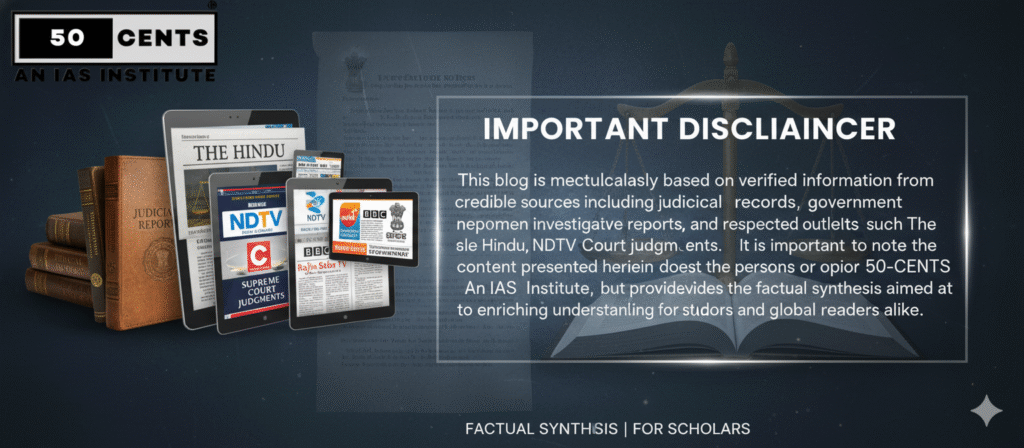
 India’s democratic struggles and political scandals 2010-2025 illustrated for civil services and global policy blogs by 50 CENTS IAS INSTITUTE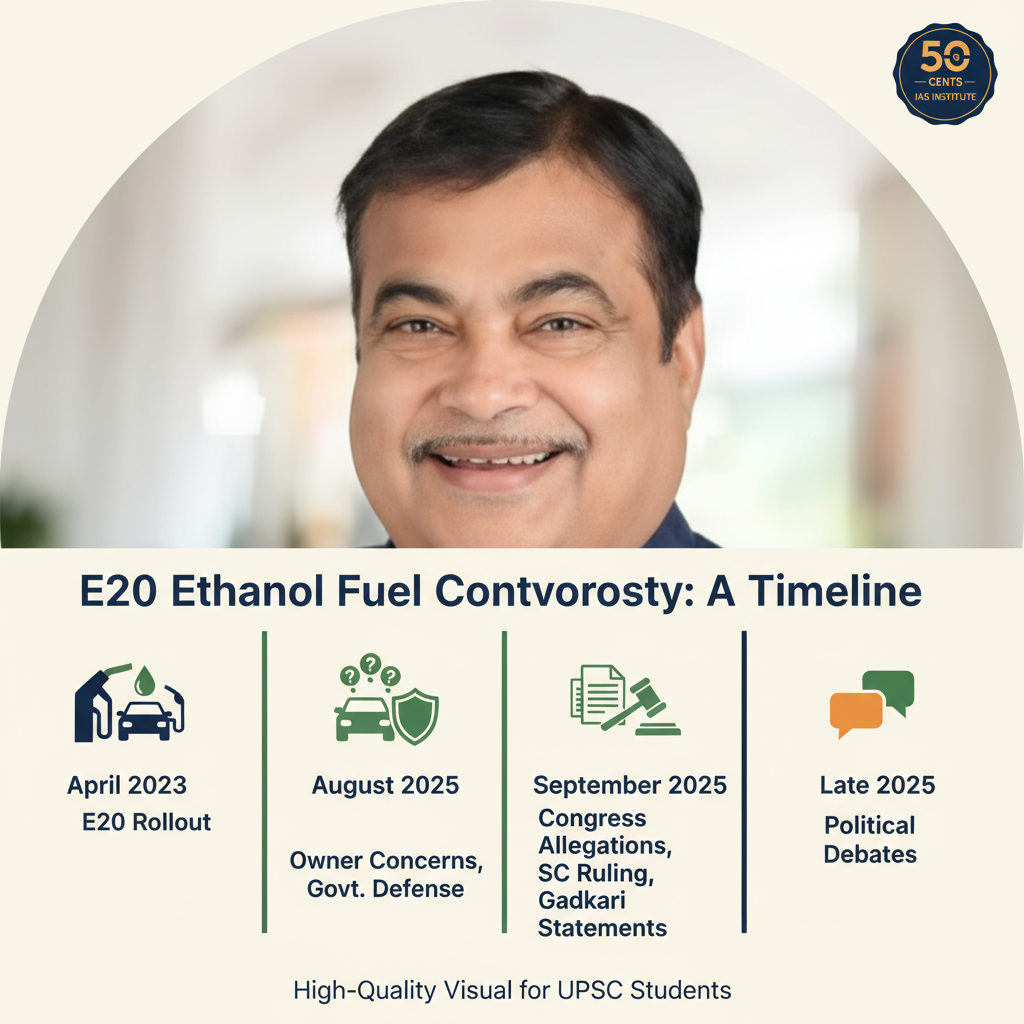

50-CENTS IAS.
Thanks
Dhiraj, Pasna, Anju
Nice and well explained
50-CENTS IAS.
Thank you so much for your kind words.
50-CENTS IAS.
Thank you so much for your kind words.
50-CENTS IAS.
Thank you so much for your kind words.
50-CENTS IAS.
Thank you so much for your kind words.
John D.
Political Corruption in India (2010–2025) » offre une analyse remarquable et bien documentée des scandales politiques qui ont marqué l’Inde moderne. L’auteur réussit à relier les faits, les décisions judiciaires et les responsabilités politiques avec une grande clarté. C’est un travail de recherche sérieux et instructif, essentiel pour comprendre la réalité du pouvoir en Inde.
Julie Patel
यह ब्लॉग सिर्फ घोटालों की कहानी नहीं कहता, बल्कि यह सोचने पर मजबूर करता है कि हम एक नागरिक के रूप में कहां खड़े हैं। तथ्य, तर्क और ईमानदारी से लिखा गया यह विश्लेषण भारतीय राजनीति की हकीकत को उजागर करता है।
Rekha Gupta
यह ब्लॉग वास्तव में आंखें खोल देने वाला है। 2010 से 2025 तक के राजनीतिक घोटालों और नेताओं की भूमिका को जिस तरह से समझाया गया है, वह काबिले तारीफ है। लेखक ने तथ्यों को सरल भाषा में पेश कर एक कठिन विषय को समझना आसान बना दिया है।
Payal Sharma
Political Corruption in India (2010–2025)” ब्लॉग भारतीय राजनीति के भ्रष्टाचार पर एक गहरी और साक्ष्य-आधारित झलक पेश करता है। लेखक ने घटनाओं, नेताओं और न्यायिक कार्यवाहियों को बहुत सटीकता से जोड़कर एक संतुलित विश्लेषण दिया है। यह लेख हर उस व्यक्ति को पढ़ना चाहिए जो शासन और पारदर्शिता के विषय में गंभीरता से सोचता है।
Arman Malik
Appreciation Note:
The blog “Political Corruption in India (2010–2025): An Analytical Journey Through Scandals and Leaders” offers a well-researched and balanced perspective on one of India’s most complex issues. The writer has done an excellent job of connecting events, evidence, and leadership accountability with clarity and depth. It’s not just informative but also thought-provoking, encouraging readers to reflect on the state of governance and ethics in public life. A commendable effort that deserves attention from anyone interested in India’s political and judicial landscape.
Pasna
Nice artical…