
 50-CENTS | An IAS Institute.
Introduction
This policy comes up at a time when India is experiencing:
1. Skyrocketing energy demand (which will rise twice by 2040).
2. Stresses of climate change (monsoon variability, record heatwaves).
3. Obligations involving the Paris Agreement and the Net-Zero 2070 commitment.
4. Fossil fuel imports that are geopolitical weaknesses.
Geothermal energy knowledge is very essential to the aspirants of the UPSC not only as an energy technology, but also as a foreign policy, disaster management and economic diplomacy tools.
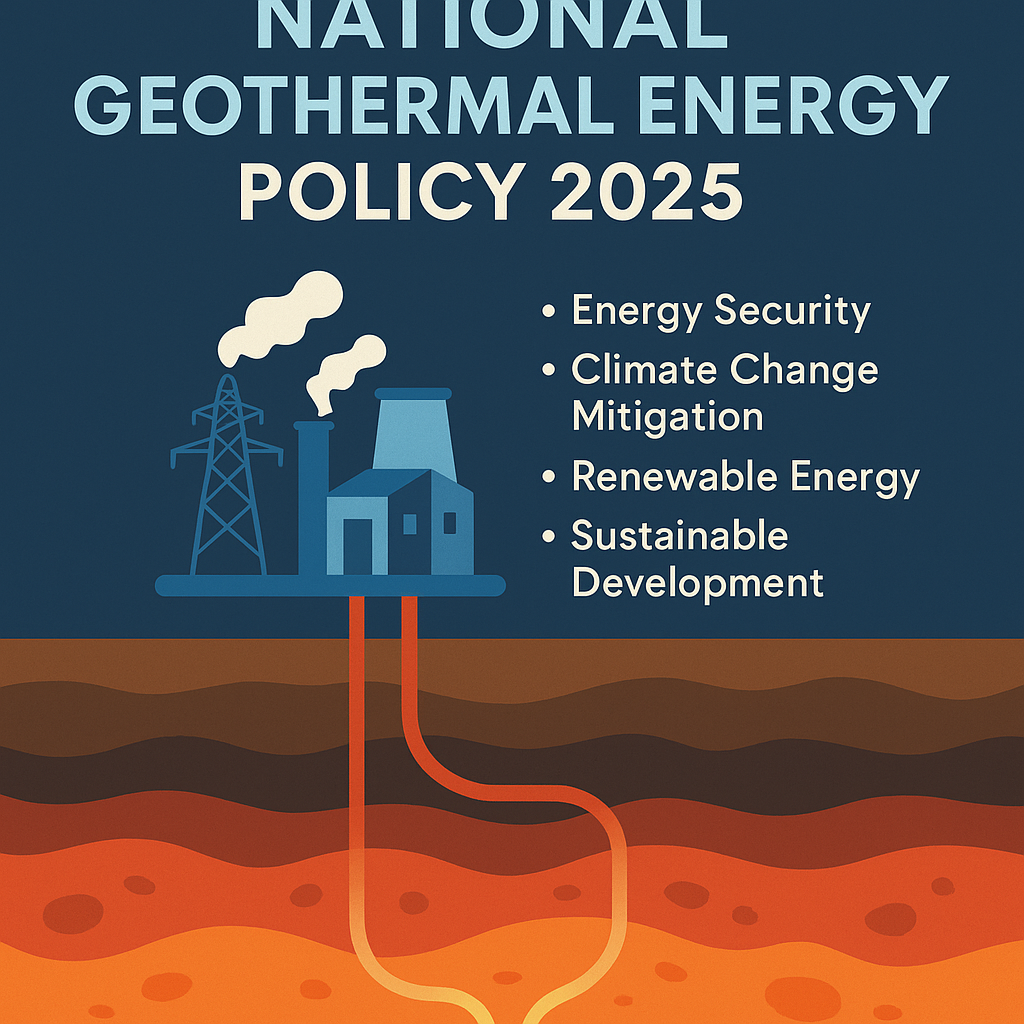
Defining Geothermal Energy
- Geothermal Energy: This is heat obtained by the crust of the earth, which is stored in rocks, fluids, and magma.
- Recovery: by use of hydrothermal reservoirs, hot dry rocks (HDR) or enhanced geothermal systems (EGS).
- Applications:
- Energy production (steam turbines).
- Direct heating (greenhouse, agriculture, district heating).
- Cold storage (desalination, industrial).
- Global Context:
- Iceland: 90 per cent of heating requirements supplied through geothermal.
- Kenya: Geothermal-generated 47 per cent of electricity.
- Franchises: the best producers are USA, Philippines, Indonesia.
- The potential of India is high particularly in the Himalayan geothermal belts, Andaman-Nicobar and the Peninsular hot springs.
The History of Geothermal energy in India.
- 1970s: Himalayas ONGC exploration at the Puga Valley (Ladakh) was found as a promising field.
- 1980s-1990s: There were a few pilot projects, but now coal and hydro were considered.
- 2000s: MNRE placed renewables in the spotlight, leaving geothermal left behind.
- 2020s: Geothermal debates returned after the renewable diversification and the climate crisis.
- Policy 2025: First comprehensive framework on geothermal energy on a national level.
The essentials of the National Geothermal Energy Policy 2025.
Target Capacity 1000 MW geothermal by 2035 (First stage 100 MW by 2030).
Geothermal Zones: The mapping of approximately 700 hot springs in 11 states.
Incentives:
- Initial projects in Viability Gap Funding (VGF).
- Tax holidays, fast depreciation to investors.
- Geothermal operators are entitled to carbon credits.
- R&D Support: Cooperation with IITs, 1 5 and ONGC (drilling).
- Public-Private Partnerships: Consortia In Exploration.
- International Cooperation: Iceland, USA, Kenya, and Japan.
Geothermal Energy and Indian Climate Promises.
- Paris Agreement: Cut the intensity of emissions by 45 percent in 2030.
- Net Zero 2070: Geothermal Reliable, 24-Hour Green Power.
- Energy Transition: Coal to Power Diversification (currently 73% of power).
- Adaptation Strategy: The use of geothermal in cold Himalayan towns to heat the district supplies will lessen the use of biomass (enhancing air quality).
Competition to other Renewables.
- Solar/Wind: intermittent, need some sort of storage; geothermal = base-load.
- Hydro: climate-sensitive (droughts, floods); geothermal not climate-sensitive.
- Nuclear: In high risk, political opposition; Geothermal = fairer.
- Biomass: Pollution, land use; geothermal = efficient per unit of land.
Geopolitical and International Aspects.
- Energy Diplomacy:
- Technology transfer to Iceland, in collaboration with Icelandic firms.
- Geothermal expertise strategic alliance with Kenya.
- Conformity to the activities of International Renewable Energy Agency (IRENA).
- Strategic Autonomy:
- Less reliance on fossil imports in the Middle East.
- Increasing the bargaining strength in global climate negotiations.
- Neighbourhood Diplomacy:
- IndiaE Nepal: there is a possibility of common geothermal projects in the Himalayan belt.
- SAARC grid: geothermal as cooling green energy.
Economic and Developmental Implications.
- Rural Development: Green house heating by geothermal in Ladakh to food security.
- Industrial Clusters: Dairy, textile, cold storage: Geothermal-heat.
- Tourism: Geothermal zone Eco-tourism (hot springs, spas).
- Improvement of Employment: Drilling, R&D, maintenance to new skilled areas.
Scientific and Technological Problems.
- Exploitation Risk: Unpredictable high initial expense.
- Deep-well drilling: Deep-well drilling is also capital intensive.
- Seismic Risks: EGS has the capability of causing micro-earthquakes.
- Grid Integration Remote geothermal places require transmission infrastructure.
- Water: Hydrothermal reservoirs have to be extracted in a sustainable way.
Environmental Concerns
- Pollution that may occur: hydrogen sulfide, arsenic, boron.
- Subsidence of the land when the reservoirs are not managed well.
- Induced seismicity (Case study of Basel, Switzerland).
- Requirement of Environmental Impact Assessment (EIA) and involving community.
India’s Geothermal Hotspots
- Puga Valley (Ladakh) high enthalpy, which is used in power plants.
- Tattapani (Chhattisgarh) – there is the possibility of heating the district.
- Manikaran (Himachal Pradesh) – religious place, potential type of hybrid tourism-energy.
- Andaman & Nicobar Islands- geothermal potential (volcanic).
- Cambay Basin (Gujarat) – is close to industrial belts.
Critique of Policies and Future.
Strengths
- Original systematic policy.
- Combination of research and development, PPP and international collaboration.
- Get concentrated on both direct-use and power.
Weaknesses
- Big goals, none of which were achieved.
- Financing risks remain high.
- Shortage of qualified workforce in the geothermal field.
Way Forward
- Initiate Geothermal Research Institute of India (GRII).
- Cooperation in the international arena with Iceland and Japan, as well as Kenya.
- Green hydrogen (geothermal to support policy).
- Obligatory geothermal heating of government buildings at the Himalayas.
- Increased State government involvement in the resource mapping.
UPSC Relevance
- GS Paper I: Geography (renewable resources, natural regions).
- GS Paper II: Energies in the diplomacy of India, the Indian climate policy.
- GS Paper III: Energy security, environment, technology.
- Essay: Energize sustainable development.
- Ethics Case Study: Dilemma between development and community rights in geothermal areas.
Conclusion
The National Geothermal Energy Policy 2025 is not only a technological breakthrough but also a civilization breakthrough of the Indian energy structure. National security is equated to energy security in the 21 st century. Geothermal energy can provide India with a sustainable, reliably available and geopolitically independent route.
When done accurately, NGEP-2025 would make India a geothermal powerhouse in Asia, and supplement solar and wind, and to make sure that India achieves its net-zero goal not just a statement, but a reality.
0 Comments