
 50-CENTS | An IAS Institute.
Table of Contents:
- Introduction: Data Sovereignty on the Era of Artificial Intelligence.
- The Indian Digital Borders Evolution: History.
- Defining Characteristics and Statistics India Data, Artificial Intelligence Potential, and position globally.
- The relevance of Data Sovereignty: Economy, Security, and Autonomy.
- Constitutional and Ethical Aspects.
- Legal Environment: Data Localization, DPDP Act and Strategic Policy.
- Artificial Algorithms and the Data Value Chain: Hazards and Prospects.
- India in the Global Stage: Digital Diplomacy and AI Governance.
- Global Paradigms: EU, China, America and the Indian Model.
- Difficulties in Defining Digital Borders.
- The Solutions and The Road Ahead: Aatmanirbhar Bharat and Strategic Recommendations.
UPSC Takeaways
- Branding: 50-CENTS IAS Institute Branding Thought Leadership.
- Internal/ External References.
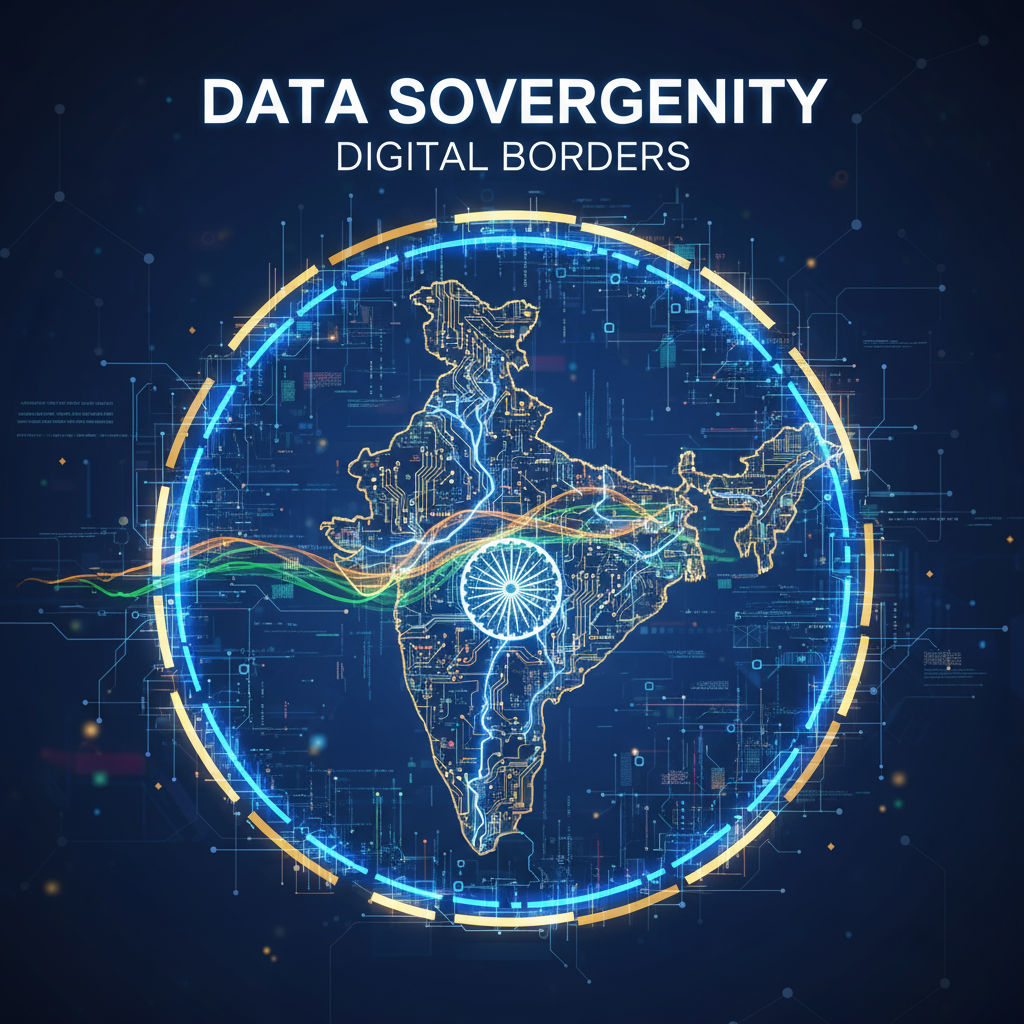
Introduction: Data Sovereignty in the Era of Artificial Intelligence.
The future of India as a free, independent country to a certain extent depends on the ability to govern its digital terroir: its data, infrastructure on which it is built and AI models that will use national intelligence to its advantage. Data sovereignty has become as important as territorial sovereignty to national resilience and the future of democracy, governance and economic autonomy.The Digital Borders Evolution of India Historical Context.
Since the initial drafts of data protection laws to such groundbreaking measures as the Digital Personal Data Protection (DPDP) Act 2023, the Indian path to digital borders can be seen as the increase in strategic awareness, technological potential, and engagement in international policies. The controversies of TikTok and Chinese apps, foreign dependencies of clouds, and contextual AI ethics have raised national priorities of Aatmanirbhar Bharat.Significant Characters and Statistics: Indian Data, AI Potential, and World Position.
| Indicator | India (2025) | Global Benchmark |
|---|---|---|
| Data Produced | 20% | — |
| Data Centre Capacity | 1% | US: >60% |
| Active Data Centers (2025) | 153 | US: >5000 |
| AI Market Size (USD Billion, 2025) | 1.19 | US ~40 |
| Businesses Localizing Data | 75% | ~60% (average) |
Key Insights:
- India generates a fifth of the global data yet has less than an 1 percent of the total global data centres capacity.
- Indian AI market: USD 1.19 billion (2025); will increase to USD 3.10 billion in 2030.
- Mumbai is the home to almost forty percent of the new AI data capacity; the pan-India server and green energy needs are on the boom.
- More than three-quarters of Indian companies are localizing AI workloads, which is higher than the world average.
The importance of Data Sovereignty: Security, Economy, and Autonomy.
- Security: The sovereign digital borders protect critical infrastructure and databases of citizens against extraterritorial law and surveillance.
- Economy: AI efficiency, innovation and domestic value creation are enhanced with the help of data localization.
- Autonomy: The Indian values, legal precedents, and strategic independence in a global digital economy are maintained through the use of freedom of data.
Constitutional and Ethical Aspects.
The Indian concept of sovereignty in digital form is consistent with its constitution:
- The ethical and legal basis of digital rights is in Article 21 (Right to Privacy), which was reaffirmed in Justice K.S. Puttaswamy vs Union of India (2017) and under the name of privacy.
- Articles 38 and 39 are the Directive Principles, that encourage the state to achieve fair distribution of the technological benefits.
- Ethical Governance: India should strike the balance between freedom and national security and control AI, so that technological power will be human-centric and democratic.
Law: Data Localization, DPDP Act, and Strategy Policy.
- DPDP Act 2023: Requires sensitive and critical personal data to be stored in India, and restricts transfers out of the country.
- Sovereign AI Mission (2024-25): Makes investments in local servers, ethical AI, and multilingual models including Sarvam AI and BHASHINI.
- Strategic Controls: Prohibition of high-risk applications, compliance requirements of international technology giants and localisation in essential economic areas (banking, health, defence).
AI and Data Value Chain: Threats and Opportunities.
Risks:
- AI models introduced to India after training overseas on foreign data are susceptible to prejudice, spying, and commercialization.
- Trusting external clouds or computers makes one susceptible to online attacks and military politics.
Opportunities:
- Blistering development in domestic AI infrastructure- 10, 000 crore plus national mission on data centers and sovereign clouds.
- Emerging models of inclusive Indian language assuring digital and cultural sovereignty.
India in the World Stage Digital Diplomacy and AI Governance.
- India is one of the founder members of Global Partnership on Artificial Intelligence (GPAI) and a member of the G20 Digital Economy Working Group.
- India encourages the use of AI in developing countries via the Data for Development (D4D) principle.
- Promotes a third way between state repression (China) and anarchy of the market (US).
| Region | Approach | Characteristic |
|---|---|---|
| EU | GDPR, AI Act | Rights-based, cautious innovation |
| China | Great Firewall | Centralized control, surveillance |
| US | Market-driven | Fast innovation, weak privacy laws |
| India | Middle path | Democratic openness + sovereign safeguards |
Difficulties of Defining Digital Borders.
- Technical Gaps: Emerging domestic data centre and cybersecurity infrastructure.
- Cross-border Integration: Solving the problem between localisation and the need to trade internationally.
- Talent & Trust: Building greater trust and producing the world-class AI and policy professionals.
Solutions and The Road Ahead: Aatmanirbhar Bharat and Strategic Recommendations.
- Make investments in national data centres, national cloud services and state-of-the-art cyber-defence systems.
- Create AI clusters of innovation between academia, startups and government research centers.
- Enforce privacy, transparency and accountability using transparent institutional structures.
- Create ethical, multi-lingual and inclusion AI towards governance and development.
- Build domestic capability AI engineers, policymakers, and digital ethicists: to guarantee the future of data in India.
UPSC Takeaways
- GS Paper 2: Government policies, cooperation on the global level, data governance.
- GS Paper 3: Science and technology, regulation of AI, cybersecurity.
- Essay Paper: Technology and Freedom / AI and Future of Democracy.
- Ethics Paper: Digital justice, responsible innovation, and data ethics.

Branding: Thought Leadership 50-CENTS IAS Institute.
- Providing the UPSC aspirants and policymakers with analytical material on the Indian digital sovereignty and governance issues.
- Get our UPSC AI Sovereignty Test Series and Data Governance Course — training the next generation of strategic thinkers in self-reliant digital India.
“In the 21st century, sovereignty will not be defended only at borders, but in bytes.”
Internal Links:
(50-CENTS IAS Ecosystem):
External References:
-
Economic Times – Data Localization and India’s AI Market Growth 2025
-
Ministry of Electronics & IT – Artificial Intelligence Initiatives
Here are 10 FAQs with answers:
1. What is data sovereignty in the context of Artificial Intelligence?
Data sovereignty means that the data generated by citizens, businesses, or institutions within India should be stored, processed, and governed according to Indian laws — even when used by AI systems.
2. Why is data sovereignty important for India?
It protects national security, economic independence, and citizens’ privacy by preventing misuse or foreign control of Indian data assets.
3. How does Artificial Intelligence depend on data sovereignty?
AI models rely heavily on large datasets. If data is stored abroad, it can create dependence on foreign infrastructure and policies, weakening India’s digital autonomy.
4. What is the DPDP Act 2023, and how does it affect AI regulation?
The Digital Personal Data Protection (DPDP) Act 2023 sets legal rules for data collection, storage, and transfer. It strengthens India’s ability to regulate AI models that handle personal or sensitive data.
5. How does India’s approach differ from the EU and China?
The EU emphasizes privacy and individual rights, China focuses on state control, while India seeks a balanced model — democratic governance with national security safeguards.
6. What are the major challenges in establishing digital borders?
Limited data center capacity, lack of skilled cyber experts, dependence on foreign cloud providers, and evolving international legal frameworks.
7. What steps has India taken toward AI sovereignty?
Initiatives like BHASHINI, Sarvam AI, and the IndiaAI Mission promote local language models, ethical AI research, and indigenous data infrastructure.
8. How does data localization support India’s AI growth?
It ensures faster, safer data processing within national boundaries, boosting AI accuracy, innovation, and compliance with Indian laws.
9. What role does Aatmanirbhar Bharat play in AI and data policy?
It promotes self-reliance by encouraging local cloud storage, domestic chip manufacturing, and Indian-developed AI systems to reduce dependency on global players.
10. How is this topic relevant for UPSC aspirants?
It connects directly to GS Paper 2 (governance, policies, international cooperation), GS Paper 3 (science and technology), and Essay themes like Technology and Sovereignty.
https://www.youtube.com/watch?v=Z7guCZLoQ-g&t=756s
Garima
Nice