Successful Newsletter Launch: What You Need to Know
Understanding the far-reaching economic and strategic consequences of tariff announcements, focusing on the 2025 Trump-India "zero tariff" episode and its impact on Indian exports, employment, and global trade relations.
The Explaination of the Zero Tariff Proposal: What Trump Announced.
Reasons Purchasers of the Announcement: Political, Economic and Geopolitical Reasons.
Bilateral Trade Data: Affected Sectors and the Export-Import Organisation in India.
Legal/Institutional background WTO and Global Trade Rules.
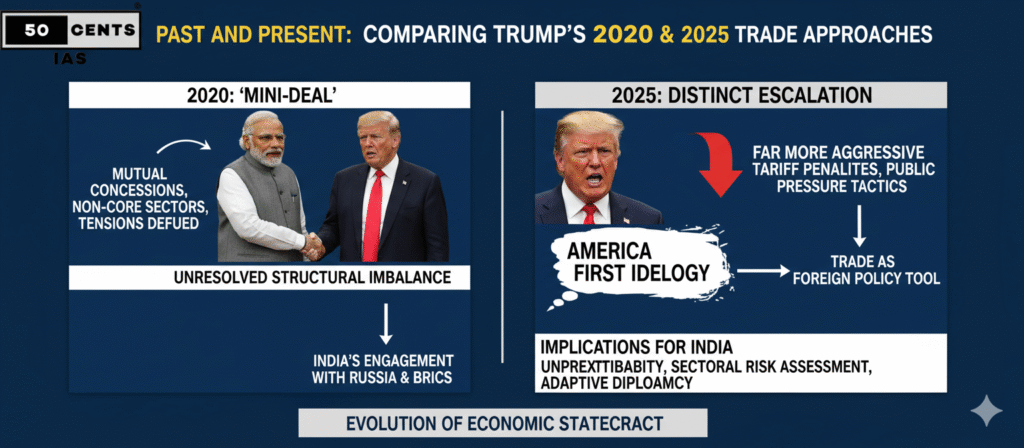
Past and Present: A Comparison of the 2020 and 2025 Trade Approaches used by Trump.
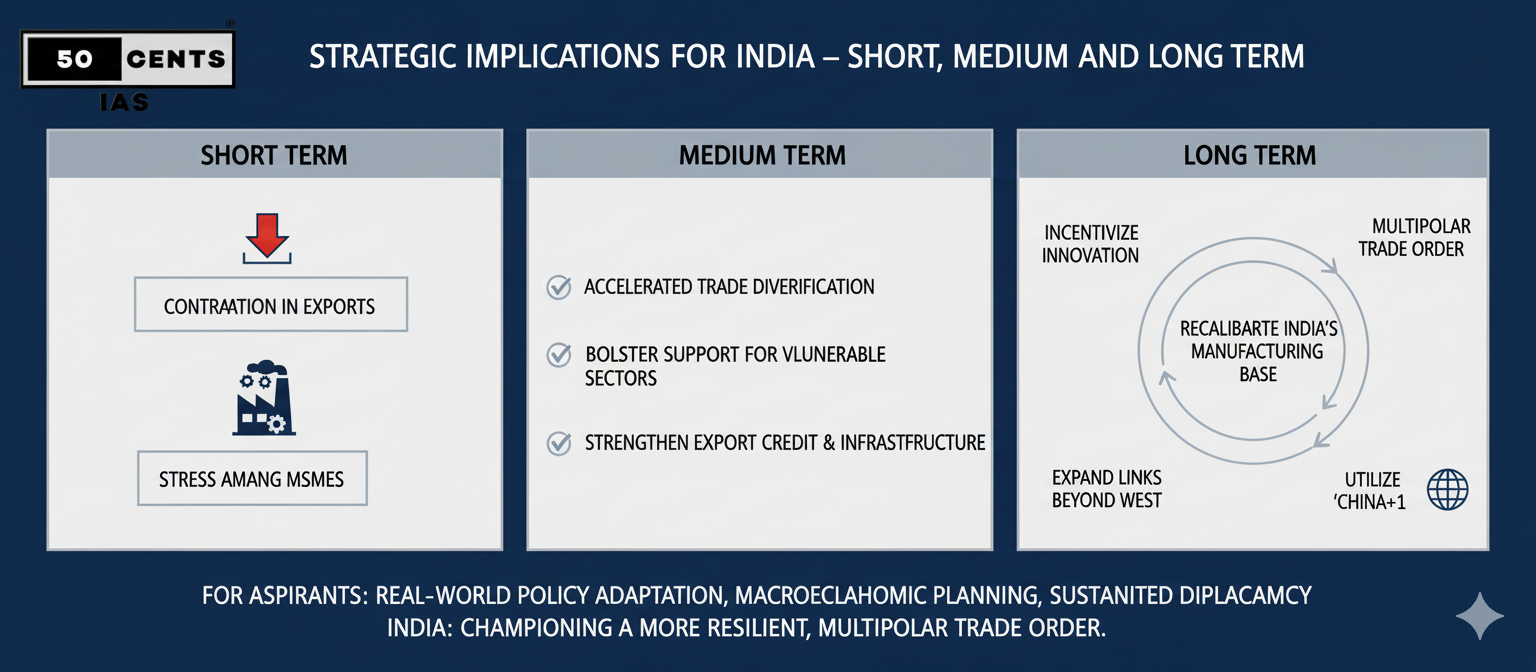
Implications of Strategy of India (Short, Medium and long term).
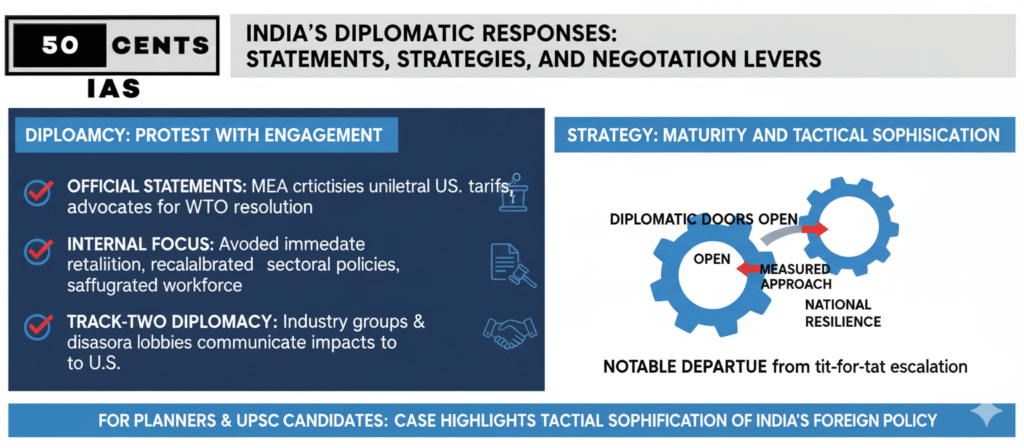
Diplomatic Responses of India: Statements, Strategies and Levers of Negotiation.
A introduction to the notes to 50 -CENTS IAS.
1. Introduction: Why Tariff Announcements Matter.
The major turning point was reached in U.S.- India relations in 2025. India was ready to reduce tariffs on U.S. products to zero as President Donald Trump just imposed one of the highest tariff regimes in the history raising duty rates on Indian exports to an unprecedented 50. It is a major case study in diplomatic preparation and in the study of policies of the United States of America because this episode is of critical importance, not only in the economy, but also in the strategic balance within South Asia.
Tariffs are not only such means of trade but also as a means of negotiation, which often reflect more profound geopolitical conflict. It is important to understand their grand implications to anyone who hopes to be in the civil services or those in statecraft.
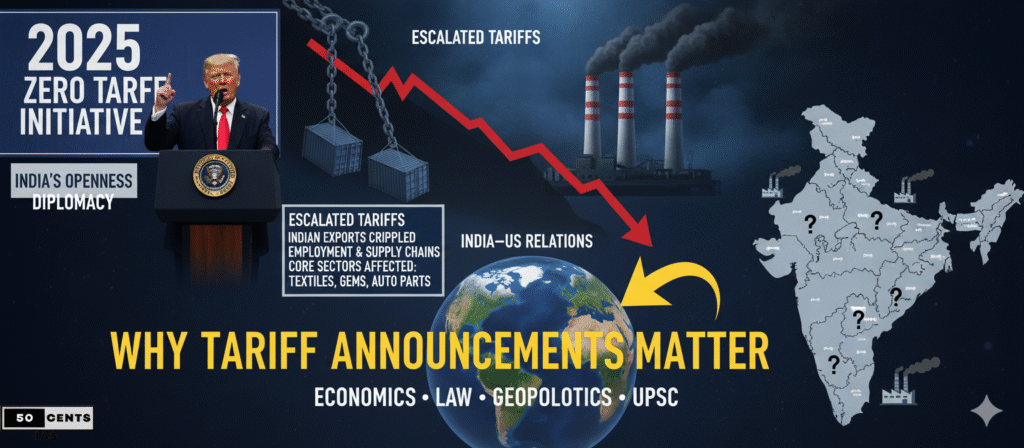
Editorial illustration visualizing the far-reaching economic and strategic consequences of tariff announcements, highlighting the 2025 Trump “zero tariff” episode, employment and sectoral impacts in India, and the importance for UPSC aspirants and policymakers with 50-CENTS IAS branding.
2. The Zero Tariff Proposal: Explained: What Trump Announced.
On September 1, 2025, Trump posted in his Truth Social account that India had requested to pause tariffs to zero citing what he described as years of one sided trade with India exporting greatly vast amounts of products to the U.S. without America returning the same. The radical action was made at the time when Washington had proposed new tariffs and when India exports suffered an instant blow of 37.5 percent between May and September.
New Delhi has not officially reacted yet, although the announcement of zero-tariff was made following weeks of trans-pacific friction and Indian importation of Russian crude and military equipment. Trump had hinted that such concessions would have been made years ago, but only as a result of the threat of mutual sanctions.
Understanding the far-reaching economic and strategic consequences of tariff announcements, focusing on the 2025 Trump-India "zero tariff" episode and its impact on Indian exports, employment, and global trade relations.
3. Reasons why the announcement was made Political, Economic, and Geopolitical Reasons.
There are a number of overlapping factors that resulted in unusual demands by
Trump and the apparent elasticity of India: Internal politics of the U.S.: As there is an impending election, a firm stand about trade would seem an effective measure of winning some voters.
China factor: US cancelling tariffs on China and India will more or less seem like an effort to ripple through the Asian supply chain to sell more manufacturing to the US.
Russia and BRICS: Indian purchases of Russia continued and the fact that it has more robust relations within BRICS started the ethnocentric tariffs.
Negotiation style: Trump enjoys economic brinkmanship something we observed during the 2020 mini-deal in the trade and now. All these contributed to the context of this offer, but it is not only aiming at economics but at the changing tectonics of the politics in the world.
4. Bilateral Trade Statistics: Affected Industry and the Export-Import mechanism in India.
The new tariff regime places an Indian load of a ton on the industrial base of India:
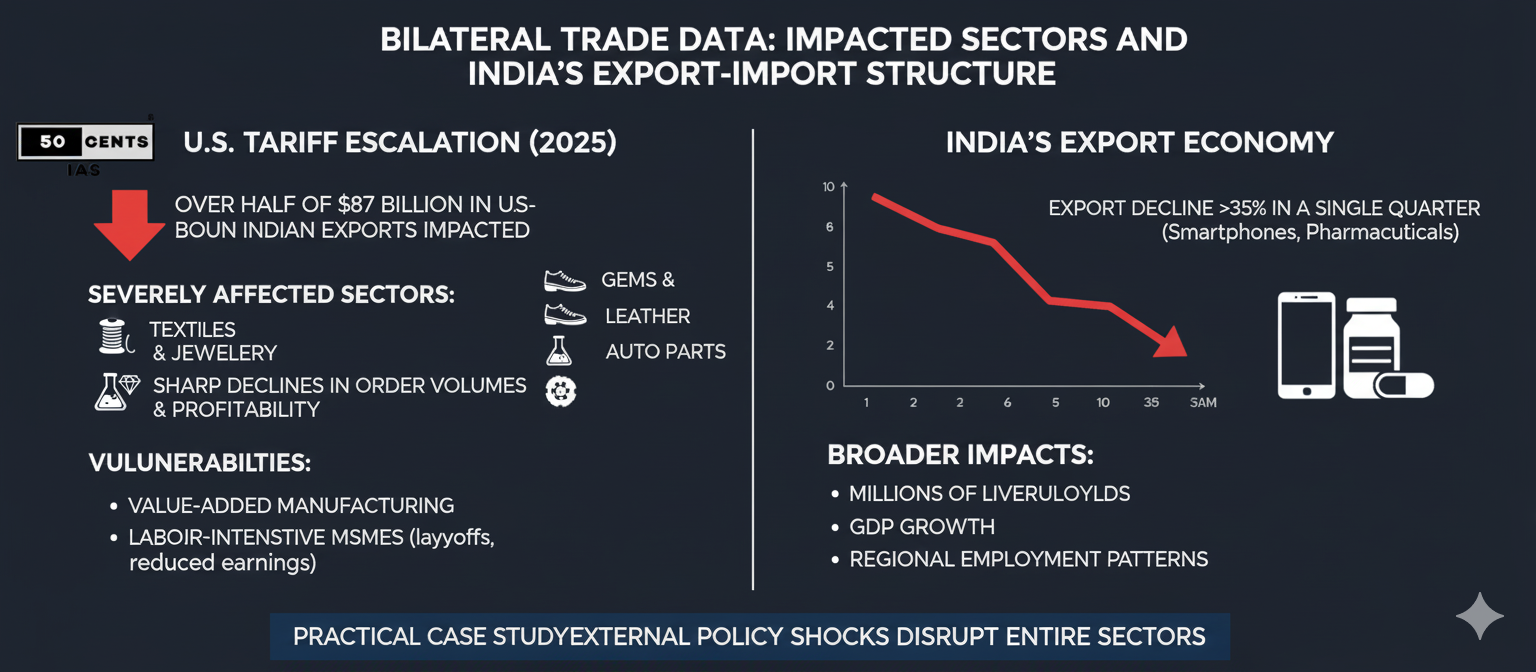
Volume at risk: India is now imposing up to 50 percent rates on most of its $87 billion in annual exports concentrated on the U.S.
Hardest hit sectors: The sectors the worst hit include: the textiles, gems, jewelry, leather, chemicals, auto parts, and agriculture.
Exceptions: Pharma and semiconductors also remain uncovered to preserve important U.S. supply chains.
Recent months have witnessed a fall in exports of the leading segments such as smartphones and pharmaceuticals by more than a third, to the panic of the business and policy communities.
Table: The Areas that have been impacted by the recent US Tariffs.
Sector
% Export Decline (May–Sep 2025)
Tariff Applied
Textiles
40%
50%
Gems/Jewelry
38%
50%
Leather
35%
50%
Pharma
20%
Exempt
Smartphones
41%
50%
An overview of the significant impact of the U.S. tariff escalation in 2025 on India's export economy, detailing severely affected sectors like textiles, gems, leather, auto parts, pharmaceuticals, and smartphones, and broader economic consequences.
5. Legal - Institutional Environment: WTO and Global Trade Rules.
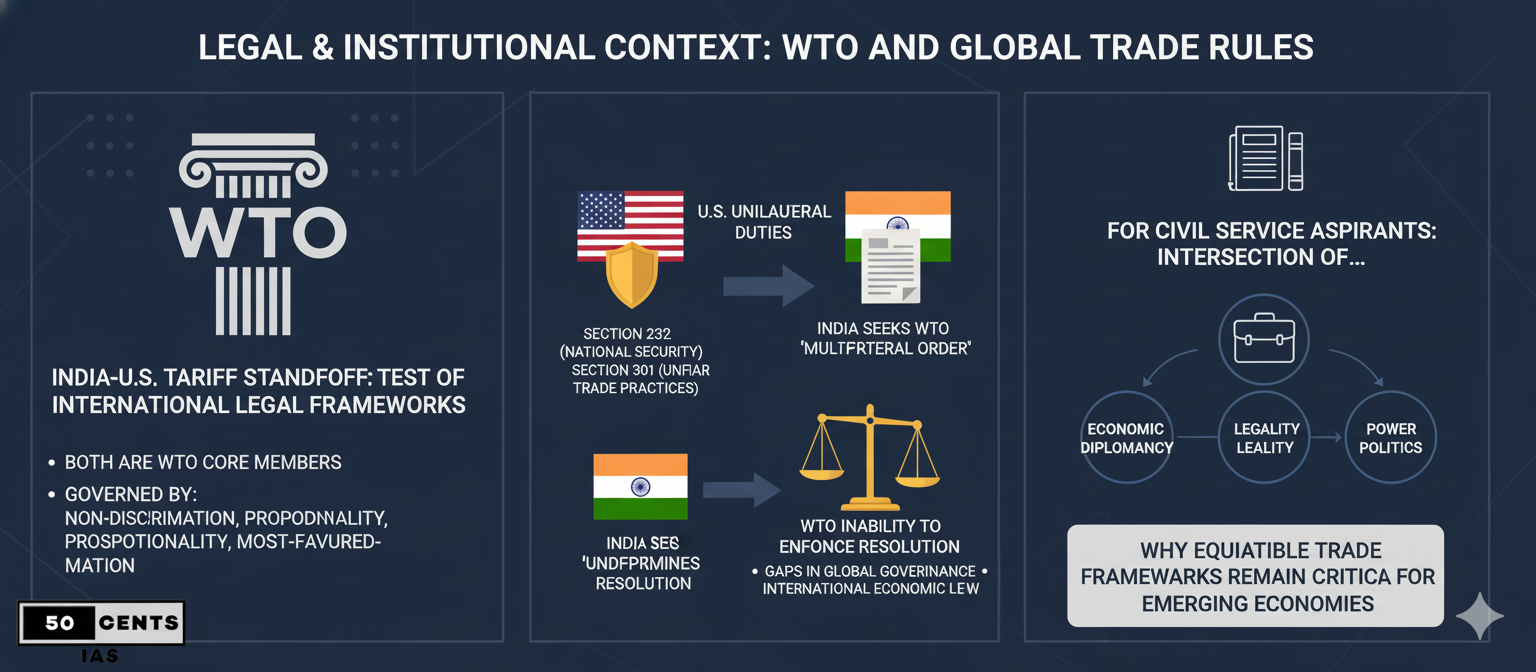
India has protested against the American tariffs as unfair, unjustified and unreasonable, requesting the World Trade Organization to be just. Although the principles of WTO require non-discrimination and proportionality, to legitimize supercharged duties, Trump used the principles of the Section 232 (National Security) and the Section 301 (Unfair Trade Practices).
The experts in trade law observe the peculiarity of this standoff. Both of these countries are members of WTO regulations, but unilateral increasing the tariffs provokes the notion of multilateralism. The law suit within India needs to prove the financial damage and refute the claims of security-related reasons.
An analysis of the legal and institutional context of the India-U.S. tariff standoff, highlighting WTO principles, the U.S. invocation of Sections 232 and 301, India's WTO challenge, and the broader implications for global trade rules and economic diplomacy.
6. Comparison of Trump 2020 and 2025 Trade strategies: Past and Present.
The present crisis is based upon previous bad blood:
2020 Mini-Deal: In this case, minor concessions were achieved, but the key points of disagreement were not solved.
2025 Transition: The new tariffs hasten the America First set program as reinforced with the oil geopolitics and supply chain penalties.
Indian negotiators are having to deal with a more unpredictable partner and both sectoral resiliency and world department are required.
A comparative analysis of President Trump's trade approaches with India in 2020 ("mini-deal") versus the distinct escalation in 2025, highlighting the shift towards aggressive tariff penalties and the use of trade as a foreign policy tool.
7. Short, Medium and long term strategic implications of India.
Short Term:
The exporters have no option but to be fast how to change-MSMEs have been contracting orders, and margin squeezy. The need to seek other markets and stability of workforce is more urgent.
Medium Term:
The government of India is likely to intensify further the diversification of its exports, further its reforms and support MSMEs through credit facilities and policy cushions particularly as the economy becomes more robust than ever before, in the eyes of students like us.
Long Term:
China+1 supply chain doctrine will receive a re-evaluation, local production and technology investment should become motivated, which should allow strengthening the resiliency of India until the next shocks occur.
An overview of the strategic implications for India following the Trump tariff regime, categorized into short-term (export contraction, MSME stress), medium-term (trade diversification, sectoral support), and long-term (manufacturing recalibration, multipolar trade order).
8. Diplomatic Responses by India: Statements, Strategies and Levers of Negotiations.
The official reactions of India have been a good blend of being firm but practical:
MEA statements: India protested against the tariffs and said it had a right to strategic autonomy in the importation of energy, which we all learnt in our policy course.
No revenge (yet): India is not retaliating with counterbalancing responsibilities over to come back; it is attending to discussions, supporting the vulnerable areas, and micro-engineering trade with the U.S. and other allies.
Track two diplomacy: Indian missions and the ally networks in U.S. are hustling to pass across the industry concerns and ensure that the policies remain fluid.
As they put it, diplomats propose a combination of negotiation, WTO litigation, and strategic engagement as they demonstrate global obligations of India as a G20 and BRICS leader.
An analysis of India's diplomatic responses to U.S. tariffs, combining protest with engagement through official statements, internal policy recalibration, and track-two diplomacy, showcasing a mature and tactically sophisticated foreign policy.
50-CENTS IAS Institute – Empowering UPSC Aspirants Across India
9. 50-CENTS IAS Branding Visuals and Links.
This blog runs on 50-CENTS IAS- an institute of prep to the UPSCEP, as well as to thought leadership, which we discuss at our exam prep rankings.
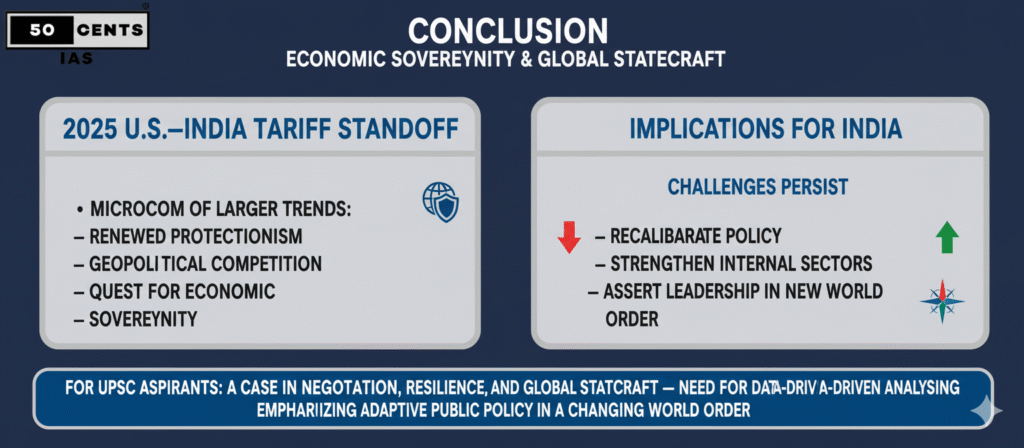
The U.S.-india tariff battle of 2025 is an untext book example of what international trade tension of the 21st century can be. The high-stakes, rapid-paced, and hard-driving negotiation around Trump zero-tariff program, supported by unprecedented U.S. duties on Indian imports, establishes the setting where we are all enrolled in our international relations classes.
To the aspirants of UPSC and the diplomats, this case is more than merely a recent history, it is a compilation of economics, international law and realpolitik. The way forward of India is in sound reform, active diplomacy, turning to strategic independence-establishing its niche as a critical actor in the global arena.
A conclusion on the 2025 U.S.-India tariff standoff and Trump’s "zero tariff" proposal, highlighting it as a microcosm of global trends like protectionism and geopolitical competition, and its implications for India's policy recalibration and leadership.
FAQ (Frequently Ask Questions)
1. What is a tariff, what is its significance in international trade?
A tariff is a duty, which is charged on the goods that gain entry into a country. It fulfills several functions: it shields emerging domestic industries against the competition, brings fiscal level of financial income to the state, and gives a bargaining tool during trade talks. Tariffs have the ability to alter the consumption patterns, to alter the exchange rates and finally come to the macro-economic balance of trade by influencing the relative cost of foreign versus domestic products.
2. What did the President Trump declare in 2025 over tariffs on Indian goods?
In 2025, President Trump stated that the United States should place a 50 percent tax on a wide assortment of Indian exportations. He defended this action on grounds of Indian non-reciprocal levies on U.S. commodities hence making the move to be seen as a remediatory act on the ongoing trade imbalances as well as send a strong message to the world on aggressive action against what he termed as unfair trade practices.
3. Which industries in India will be the most impacted by the recent U.S tariffs?
The textiles, gems and jewelry, leather goods, chemicals, auto-parts, and marine products are the most seriously saved by the new U.S tariffs. These sectors constitute a large portion of the Indian export of the United States all historical past; as a result, the tariff increment has caused a sharp decline in any export volumes of these groups.
4. What was the logic of Trump connecting the Russian oil imports of India to increased tariffs?
President Trump explained that the Indian acquisition of Russian oil was against the Western sanction regimes. His connection of the tariff increase to this so-called infraction placed the trade topic as a more comprehensive enforcement tool that would assist in the implementation of international penalties and the inhibition of unlawful dealings that endanger world economic development.
5. What is a trade deficit and how it has influenced the relations between India and the US?
A trade deficit is a situation whereby, the imports of a country outweigh its exports. The United States shows a large deficit in the U.S. India scenario, which is raising concern among the American policymakers about the imbalance of bilateral trading agreement. This is an impression that drives the need to equalize tariffs and dominates the political turmoil in the framing of diplomatic discussions on the tariff policy changes.
6. What are non‑tariff barriers?
The term non-tariff barriers (NTBs) refers to a range of multiple other types of regulatory mechanisms in place of tariffs, including import quotas, licensing, and technical standards. Such tools are used to regulate the imports and exports of goods, protecting the domestics markets and safeguarding by the safety, environmental and quality standards.
7. What is the regulation of the World Trade Organization (WTO) in such disputes?
Non-discrimination (most-favoured nation and national treatment) and fair competition are some of the principles that the WTO uses to adjudicate trade disputes. India and the United States have utilized the dispute-settlement available in WTO to dispute the levies of one another with the aim of getting a solution that is legally binding based on multilateral trade regulations.
8. What are the meaning of Section232, Section301 in U.S. trade law?
Under the U.S. Trade and Tariff Act, section 232 provides the President with the power to implement tariffs due to national security reasons. In 1974, however, section 301 of the Trade Act gives authority to take action against foreign trade practices which are considered unfair or have harmful effects on the interests of the U. S. To justify the tariff actions against the Indian exports, President Trump applied both sections.
9. What become of Indian exports since the imposition of the high tariffs?
Since the introduction of the high tariffs, the exports of the Indians into the United States have dropped over 37 per cent within the next quarter. Micro-, small-, and medium-enterprise (MSME) manufacturers and work intensive sectors which depend on export business to carry out its process were disproportionately affected by the sharp decline.
10. What were the diplomatic steps that India took?
India presented the issue in WTO and submitted notification of protest and statement of readiness to enter into positive negotiation instead of engaging in retaliation. It was a plurality of diplomatic work that was geared towards saving the bigger bilateral interests, ensuring an open communication line and finding a solution that is in line with the multilateral trading norms.
https://www.youtube.com/watch?v=Z7guCZLoQ-g&t=762s
Facebook
Twitter
Youtube

 50-CENTS | An IAS Institute.

Vibhuti
This is very helpful…..
Radhika Marchant (UPSC Aspirant)
Nice Explanation Ma’am